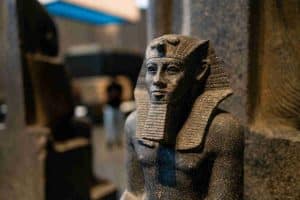
This post, in which we discuss what the nemes is, follows others on this blog where we analyze other fundamental symbols of Ancient Egypt, such as the ankh or the uraeus: they were essential to the propaganda and portrayal of the pharaohs of their time, and they appear constantly before the eyes of those who visit temples and museums. But their meaning is not always understood, so this post will help you with that.
What the Nemes Is and What It Looks Like
The nemes is a garment associated with the pharaoh, as they were the ones permitted to wear it. It is a kind of headscarf-like headdress that completely covers the head, fitted at the forehead with the uraeus and finished at the start of the back with a knot like a braid. This headdress was gathered behind the ears and could have two ends or strips that fell in front of the shoulders.
It seems to have been a garment made of white fabric, over which blue horizontal bands were arranged. However, when depicted artistically (in paintings, reliefs, or sculptures), its color could be gold (gold) and blue (lapis lazuli).
Meaning of the Nemes
As we said, the nemes is, ultimately, a symbol of power, since only pharaohs were allowed to wear it. That said, nemes have been found in the tombs of certain nobles, probably due to the belief that they offered protection in the Afterlife.
What gave it that meaning was the association of the pharaoh with a deity, as well as the strength of the lion, an animal so closely linked to the African continent: according to many interpretations, the nemes could represent the mane of this great feline.
This garment is very commonly found in funerary decoration, where a given monarch is depicted with the attributes of a god in his own tomb. In any case, it seems that pharaohs also wore it in life, on occasions of special importance, to emphasize their strength and power.
By extension, it is also possible to find creatures wearing the nemes if they are associated with a pharaoh. For example, the sphinxes that guard a royal tomb, with the Great Sphinx of Giza as the best example, though not the only one.
Some of the Most Beautiful Nemes
With a little observation during your trip, you will identify the nemes in many places. Perhaps the most famous and spectacular of all is that of the mask of Tutankhamun, especially because it is made of gold and lapis lazuli, like other details of the mask itself. Moreover, as it is on display at the Grand Egyptian Museum in Giza, upright and in a freestanding display case, visitors can admire it from every angle, including the back, where the knot or braid at the nape of the neck can be seen.
In fact, any bust of a pharaoh is a good opportunity to find this garment and view it in 360°. The Luxor Museum, for example, has numerous statues of this kind in which different pharaohs can be identified wearing the nemes: Akhenaten, Thutmose III, Amenemhat III, etc.
As for mural decoration, some particularly evocative paintings are those in the tombs of Seti I and Ramesses V/VI: the compositions, which cover walls and ceiling, show the aforementioned pharaohs wearing this garment on numerous occasions and in different situations, adding an extra sense of solemnity that the setting requires.
And of course, given its visual impact, it has always been an omnipresent garment in Hollywood films about Ancient Egypt. From the classics of the 1950s, such as The Ten Commandments, in which Yul Brynner played Ramesses II, to more recent animated films, such as The Prince of Egypt.