The Red Sea in Egypt covers an extremely wide tourist region. And although all these destinations share certain features, they are not all the same. That’s why, in this post, we explain what we mean by the “Red Sea,” and what its main areas and points of interest are. We’ll also recommend which one to choose for your trip, based on your preferences. To do so, we draw on our experience as a luxury agency in Egypt, and we can even arrange combined tours with other agencies from our Mandala Tours group.
The Different Areas of the Red Sea
The Red Sea is a large, elongated body of water that stretches between the African continent and the Arabian Peninsula. At its northern end, this sea splits into two gulfs: the Gulf of Aqaba and the Gulf of Suez, whose Egyptian coastlines border the Sinai Peninsula. We can therefore identify four distinct areas:
- Hurghada and its surroundings: right on the mainland coast
- Sharm el-Sheikh: in the south of the Sinai Peninsula
- The Gulf of Aqaba
- The Gulf of Suez
- Marsa Alam and its surroundings, in the south of the mainland coast
One feature common to all these areas is their mild climate year-round, with higher temperatures in summer and milder ones in winter. Let’s look at each one individually to understand its particular strengths.
Hurghada and Its Surroundings
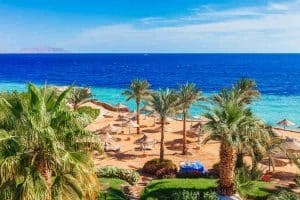
This is one of the major tourist hotspots, with numerous holiday resorts and a well-established snorkeling and diving scene, with companies and professionals capable of organizing all kinds of dives, both close to shore and further out at sea. In addition, the Giftun Islands, located just off the city’s coast, are another major draw thanks to their beauty, with day trips available. Combined with the area’s magnificent local architecture, embodied in its monumental mosques, the result is a very well-rounded tourist destination.
Sharm el-Sheikh and Its Surroundings
Established as an important business and conference hub, as evidenced by its peace summits, this is the other major tourist destination on Egypt’s Red Sea. Its range of leisure options is extensive, catering to all types of travelers. As for snorkeling, it boasts some fascinating marine reserves, such as Ras Mohammed National Park, a true paradise for divers. In addition, excursions to Mount Sinai and Saint Catherine’s Monastery add a particularly interesting cultural dimension.
Gulf of Aqaba
This is another top-tier tourist area, with smaller destinations that are nonetheless well equipped with infrastructure, especially resorts and snorkeling and diving activities. Dahab stands out, serving as a base for excursions to Mount Sinai and renowned for its proximity to the famous Blue Hole dive site. There’s also Taba, very close to the border with Israel and to Pharaoh’s Island, a popular destination for day-trippers.
Gulf of Suez
This is perhaps the area least developed for international tourism. In fact, its visitors are largely Egyptian, especially from Cairo, since destinations such as Ain Sokhna can be reached from the capital in just an hour and a half. In fact, many resorts and tourist facilities are still under construction. Of the five areas described here, it is the least suited to snorkeling and diving.
Marsa Alam and Its Surroundings
This is an area with emerging but modest tourist development, where instead of massive holiday complexes, you’ll find more minimalist-style accommodations with a quieter atmosphere. Marsa Alam and Berenice are its main destinations, drawing largely on tourists looking for a getaway from Upper Egypt (Luxor, Edfu, Aswan). And although you’ll find fewer leisure options here than in other areas, the relaxed atmosphere is ideal for unwinding, snorkeling, or even trying a water sport like kitesurfing.