
With all due respect and saving the distances, the Temple of Abydos, in Middle Egypt, is often compared to the Sacred Mosque of Mecca. Pilgrimaging to this city, which was the center of worship for the god Osiris, became a real aspiration for the ancient Egyptians, as they believed that the entrance to the other world was here.
Therefore, visiting the Temple of Abydos and all the archaeological sites in the area is essential to understand what that civilization was like and what its beliefs were. But also to admire its beauty since, despite the passage of millennia, it still preserves corners with some of the best artistic manifestations of all Ancient Egypt.
The location of the Temple of Abydos in Egypt Middle Egypt favors the fact that, despite its worldwide fame, this monument does not suffer from mass tourism. It is integrated into the town of El Araba El Madfuna, but administratively belongs to the town of Al-Balyana (or Al Belina), in the Governorate of Sohag. And the nearest city is precisely Sohag, about 50 km north of Abydos. For its part, Luxor, located further south, is about 190 km away.
This small town is located in desert terrain, just where the fertile western plain of the Nile River ends. And as you can imagine, it is a place very dependent on the tourism generated by the Temple of Abydos and the rest of the sites, as well as the crops in the area, mainly sugar cane.
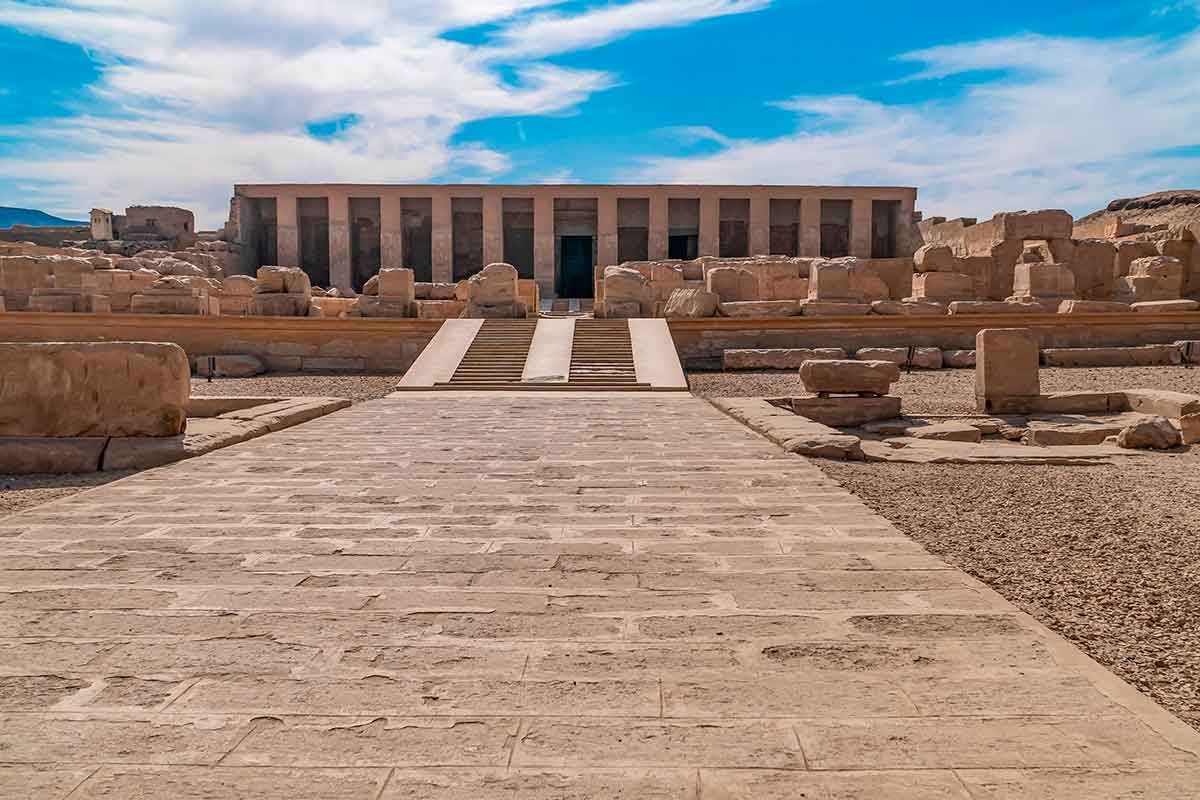
The importance of Abydos in Egypt Ancient Egypt was very great and, although its peak came during the New Kingdom, it goes back to the very origins of that civilization. In fact, it is believed that the city of Thinis, the first capital of unified Ancient Egypt, would be located in the vicinity of Abydos. And that motivated the establishment of the first great royal necropolis nearby, in Umm el-Qaab. It was, therefore, the place where important pharaohs of dynasties I and II were born and buried (ca. 3050-2700 BC), including Narmer and Khasekhemwy, among others.
Related to this primitive Egyptian culture are the clay tablets and decorated jars that were found in the burial of King Horus Scorpion I, in the necropolis of Umm el-Qaab. They were dated around 3300 BC and, therefore, are considered one of the first examples of writing. And that has led to considering this place as one of the cradles of civilization.
Although until recently the Temple of Abydos and the other religious constructions focused on this place as a religious center, the truth is that archaeological discoveries in 2016 showed that it was a city from the beginning: a settlement with more than 5,000 years old, in which remains of huts, iron tools and fragments of ceramics, as well as burials of people, have been identified.
Although the magnitude of that city is not yet clear, it is known that the Temple of Abydos was constantly expanded over the centuries. One of the main contributions was that of Pepy I (Dynasty VI, Old Kingdom). The main local deity was Khentiamentiu, but over time it was assimilated to Osiris and became the main sacred place for the worship of this god, judge of the dead in his aspiration to achieve eternal life. Mentuhotep III and Sesostris III (dynasties XI and XII, Middle Kingdom) carried out important works (tombs, temple of worship, royal chapel, etc.).
But the largest constructions came in the New Kingdom. Monarchs of the XVIII Dynasty (Ahmose I, Thutmose III), in the 15th century BC, made the Temple of Abydoslarger, with an even more monumental processional road. Shortly after, in the 14th century BC, everything stopped due to the rupture period of Amarna, with Pharaoh Akhenaten establishing a practically monotheistic cult, with the supremacy of the god of the solar disk Aten. A whole schism that shook the foundations of the Egyptian religion and relegated Osiris to the background.
However, with the fall of Akhenaten and his legacy, the rebirth of this religious center would come. And the name that has forever been linked to the Temple of Abydos is that of Seti I, of the XIX Dynasty. This pharaoh, father of Ramses II, set out to continue with the reestablishment of the Egyptian religion prior to Amarna, which other monarchs prior to him had already begun, including Tutankhamun.
And the best example of this is the Temple of Abydos which, as we will see, is also known as the Temple of Seti I. It was completed by his son Ramses II, but other later monarchs of the same dynasty made their contributions, such as Merenptah, who ordered the Osireion to be built.
Other pharaohs, such as Ahmose II of the XXVI Dynasty, carried out certain reforms. The last of which there is any record of intervention is Nectanebo I of the XXX Dynasty. After that, with the Greco-Roman period, the importance and symbolism of the Temple of Abydos in Egypt declined.
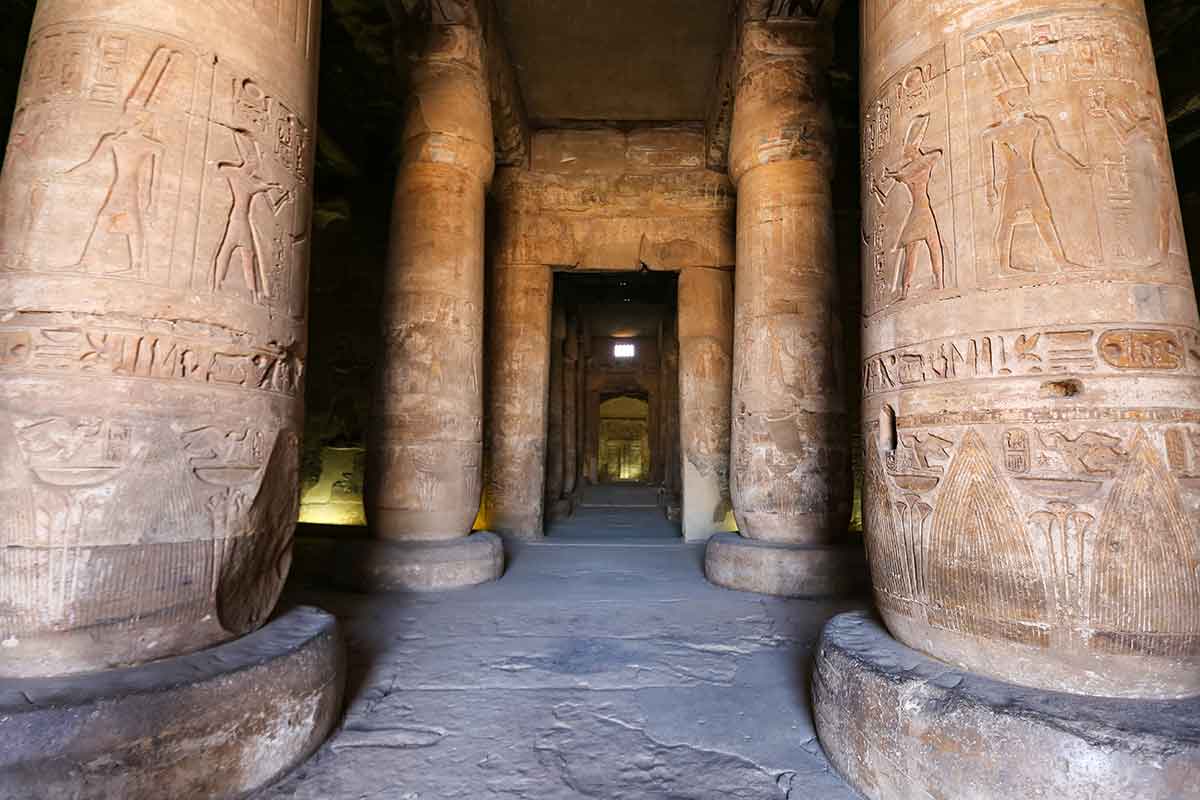
In Abydos, Egypt Ancient Egypt offers some of its most dazzling artistic manifestations. Its spectacularity and solemnity are easy to understand at first sight, but in order to appreciate all its relevance and beauty, it is convenient to know its keys. That is what you can do with the help of our expert guides, although below we give you a brief overview of the Temple of Abydos (Temple of Seti I), the Osireion and other nearby archaeological sites, such as Shunet El Zebib and the necropolis of Umm el-Qaab.
The Temple of Abydos is often known as the Great Temple of Abydos or as the funerary temple of Seti I because this pharaoh was its great promoter, although many other sovereigns from different eras participated in its construction, as we saw above. However, despite the term ‘funerary’, it should not be forgotten that it was a temple-cenotaph in conjunction with the Osireion, since the tomb and mummy of Seti I were located in the Valley of the Kings of Thebes (Luxor).
The objective of this pharaoh in the Temple of Abydos was clear: to honor all the great gods of the Egyptian religion and the pharaohs who preceded him, deliberately forgetting the monarchs considered usurpers or heretics, such as Hatshepsut and Akhenaten, as well as the reviled god of the solar disk Aten. And this was clear in two elements, absolutely key in any visit to the temple:
Many elements of the Temple of Abydos have disappeared, such as entrance pylons, but some parts of what is preserved are of extraordinary beauty and delicacy, such as the bas-reliefs of the hypostyle hall.
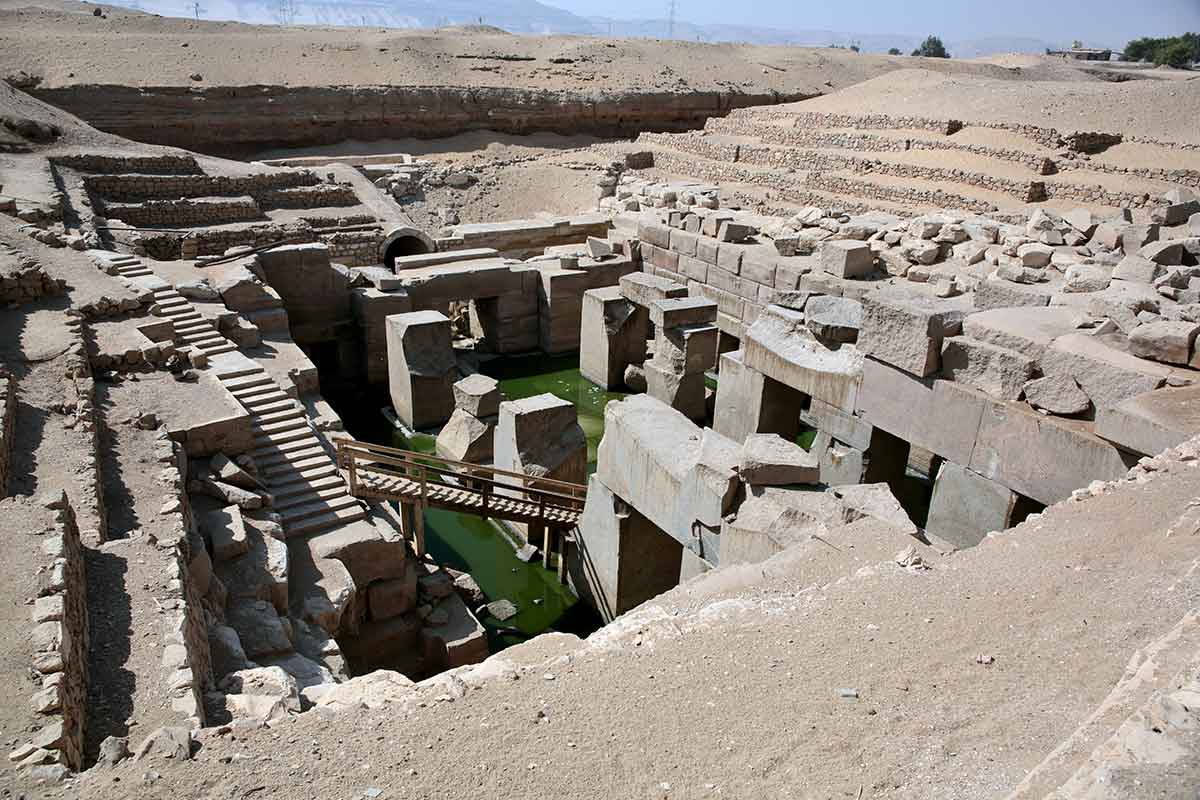
This is the cenotaph that Seti I ordered to be built next to the Temple of Abydos. Although it has reached the present day very deteriorated, researchers have identified different spaces in the structure, such as a vaulted corridor, an antechamber and a large central chamber. In some points of the Osireion, decoration in the style of the Book of Gates has been located, from the time of Merenptah, a mural type very widespread among the pharaohs in the New Kingdom, as can be seen in the tombs of the Valley of the Kings, for example.
Some authors believe that this cenotaph would seek to evoke the primordial hill and the primordial waters, present in the Egyptian theory of creation. Currently it cannot be visited because it is partially flooded by the rise in the water table of an underground aquifer.
Another place is Shunet El Zebib, also about 500 meters from the Temple of Abydos, although in this case to the north. It is a structure of extraordinary archaeological relevance: two sections of wall made of adobe bricks that date back to approximately 2700 BC, in the time of Pharaoh Khasekhemwy (Dynasty II). It was built more than 4,700 years ago and is still standing!
It is considered a precursor of the stepped pyramids due to its constructive similarities. For a long time it was believed that it had a military function and, in fact, it was called Middle Fort, but today experts are more inclined to consider it a funerary and religious structure, probably a Chamber of the Ka, where the statue of the deceased was kept, in which his life force resided ( ka).
The location of Abydos in Egypt Middle Egypt makes several options viable to get here. On the page dedicated to this area we explain how you can do it, but if you want to use the plane you should consider the options of the airport of Sohag, which is the closest, or that of Luxor, with a greater variety of flights. To get to this last city you can assess the option of the bus or, even better, the night train.
But something that is essential in any option is to have a private road transport service. Not only to travel from Sohag or Luxor to the surroundings of the Temple of Abydos, but also to do so from this place to the other points of interest, such as Umm el-Qaab and Shunet El Zebib.
In addition, having a vehicle with a driver allows you to include other visits along the way, such as Dendera, which is located between the Temple of Abydos and Luxor. This is a very common proposal among travelers, as they are two of the ancient monuments of greatest interest in Middle Egypt and throughout the country in general.
Egipto Exclusivo can provide you with this tailor-made service as part of a circuit, with a professional driver and a vehicle equipped with the best amenities, so that traveling through this area is safe and comfortable. In addition, we will take care of other fundamental details, such as accommodation or diets while you are here.
And if you want to insert these visits within your Nile cruise, we also have interesting proposals, in river tours along this great river. Get in touch with us to start planning your experience in which to visit the Temple of Abydos and the rest of the places of interest!


