
Wadi Natrun is a place full of personality, attracting thousands of tourists interested in history and religion, especially Coptic Christianity. On this page, we tell you everything you need to know about its monasteries, which were key in the early days of this religion and which today represent an unforgettable visit. Egipto Exclusivo, by the way, can bring you here on a customized organized excursion, with transportation, guide, and food, among other services.
In Christian literature from centuries ago, this place was known as the Desert of Scetis or Scete, referring to the ascetics who took refuge here and the arid environment that surrounds it. But in reality, Wadi Natrun is a valley located just between the Western Desert and the Nile Delta, where there are several lakes that dry up in summer.
Wadi Natrun is a district of the Behera Governorate, and the exact location of its monasteries is halfway between the cities of Cairo and Alexandria: about 100 km from the former and about 120 km from the latter. It is a territory with scattered settlements, where nearly 80,000 inhabitants live, many of them dedicated to caring for the farms and farmlands in the area. The nearest town is Bir Hooker.
Virtually everything you will see on your visit to Wadi Natrun is related to Coptic Christianity. But things were already happening before the rise of this religion… or even much earlier. Fossils of prehistoric animals have been discovered here, both in recent and ancient times, as referenced in Greco-Roman documents.
It would not be unreasonable to relate these remains to those of other nearby sites, such as those in the Valley of the Whales near the Fayyum Oasis, so we would be talking about a dating of tens of millions of years ago, when this area was very different: first, the bottom of the Tethys Sea and, later, a wet area full of vegetation.
There are already references to Wadi Natrun in the times of Ancient Egypt, at least since the reign of Ramses II. The reason why the pharaonic civilization set its sights on these seasonal lakes can be guessed from its name: ‘Natrun’ derives from ‘natron’, a type of mineral salt that remained here after the water of these lakes disappeared in summer.
Natron was mainly used for two purposes, both related to the funerary rites of the Egyptian religion. The first, for the treatment of the corpse of a deceased person during the mummification process, as this salt was used to impregnate the bandages that wrapped the mummy. And the second, to make the glazed pottery called ‘Egyptian faience’, with which the Ushebti or figurines that accompanied the deceased in the tomb were made.
But as we were saying, the true history of what you will see in Wadi Natrun begins to be written in Roman times, when the first Christians suffered fierce persecution for their beliefs. The desire to escape these persecutions and lead a contemplative and austere life is behind the birth of the Egyptian eremitic movement, at the hands of Saint Paul of Thebes and Saint Anthony the Abbot, who settled in the 3rd and 4th centuries in the eastern desert of Egypt.
On the other hand, on this side of the Delta, in the western desert, others followed their example and became role models. In particular, Saint Bishoi (or Bishoy), probably the founder of the first monasteries of Wadi Natrun in the 4th century. In them, the activity had a less eremitic and more monastic character, with rules that governed the secluded but communal life of its monks.
Since then, Wadi Natrun remained a refuge for Christians, both here and in the nearby monasteries of Nitria and Kellia, also in the desert. According to some sources, in Wadi Natrun and in a vast area around it, there may have been dozens or even hundreds of monasteries. But the difficult relations with the authorities of Byzantium first and with the Arab rulers later caused the closure of most of them.
In this way, only four monasteries have managed to survive in Wadi Natrun which, in addition to being tourist destinations of great interest, also maintain their religious activity. In fact, although most of the year they have a quiet appearance, on certain dates they are filled with pilgrims and faithful.
This religious activity and the isolated location of the place have allowed interesting works of art to be preserved inside. In its surroundings, on the other hand, agriculture dominates as an economic activity. As for the exploitation of natron, this fell sharply as other salts replaced this mineral at an industrial level: it can be said that the most ambitious project in this regard was the Egyptian Salt and Soda Company railway line, which connected these deposits with Al Khatatbah and, from there, to Cairo.
The tourist attractions of Wadi Natrun are, only, its four monasteries, which are also not exactly together (calculate about 25 km between one end and the other). But visiting all four is worth it, as they are all full of history and preserve structures and works of artistic interest. In its surroundings, on the other hand, you will not find other monuments worthy of mention. Below we review the four monasteries.
The Monastery of Saint Bishoy of Wadi Natrun is probably the most important of the four. It receives this name because it was founded in the mid-4th century by this saint, Saint Bishoy the Great. In fact, in one of the churches of the site, his body is preserved, which is said to be incorrupt and is taken out in procession every July 15. He is venerated by the Coptic Church and also by the Orthodox Church, under the name of Saint Paisios.
It is a fortified monastery, like most of those found in Egypt, to avoid attacks. The first was erected in the 5th century, but the current one is from the 20th century, promoted by the Coptic Pope Shenouda III, who began his monastic life here… and is also buried here.
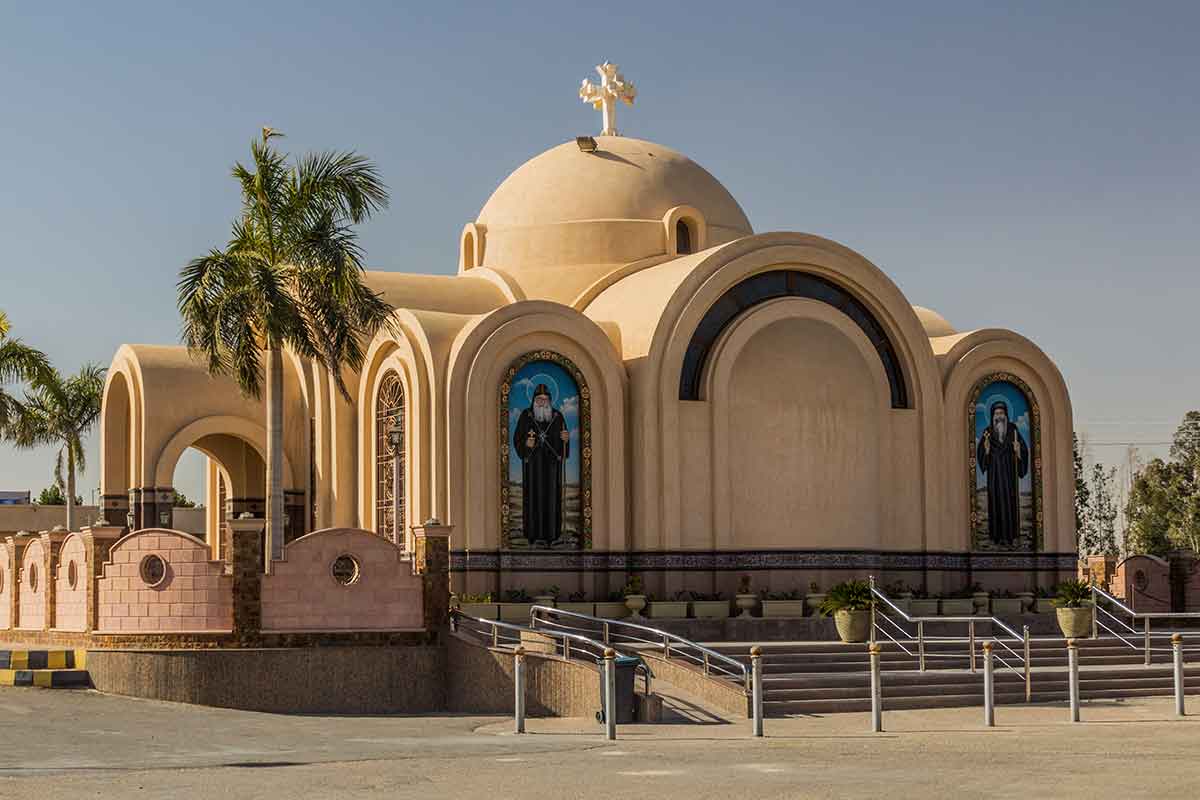
It has five churches, with simple and prominent bell towers, which provide an interesting contrast of geometric shapes with the semi-spherical shapes of the domes. The mixture of the golden color of the adobe with the green of its gardens is striking, a characteristic common to other monasteries of Wadi Natrun.
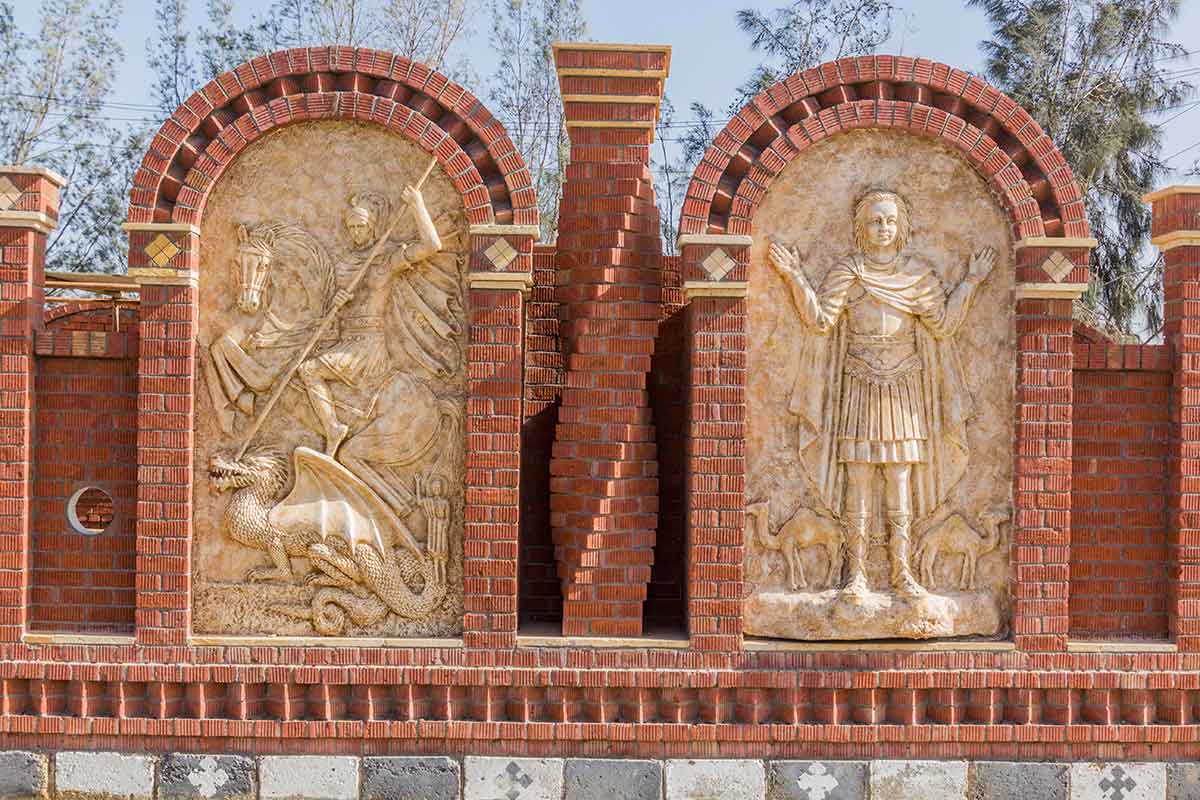
It was founded in the 6th century and is located very close to the Monastery of Saint Bishoy. It owes its name to the fact that, since the 8th century, it has been the home of Syrian monks, following a tradition rooted in Egypt of welcoming this type of religious from all over the world, as this country is considered the cradle of monastic life. And Wadi Natrun is largely ‘to blame’ for this.
However, since the 17th century it has no longer been inhabited by Syrians. In reality, its true name is Monastery of the Holy Virgin Mary, being a place for devotion and defense of the role of the Virgin as the mother of God. The elements of greatest interest in the monastery are its fortress and its churches.
With regard to the fortress, its height and also its doors stand out, some of them drawbridges. As for the churches, the most important is that of the Holy Virgin Mary, in which its Door of Predictions, its altar, and its vaults stand out, with decoration of frescoes and engravings. The cave in which Saint Bishoy prayed is also preserved, and you can see the point on the ceiling where he tied his hair so as not to fall asleep during nocturnal prayers.
This is another of the primitive monasteries of this complex, in this case founded by Saint Macarius in the mid-4th century, one of the spiritual references of the Egyptian monastic movement and who ended up in Wadi Natrun for his spiritual retreat.
This monastery also enjoys great prestige because numerous Coptic popes have come from here. It also preserves important relics, such as that of the ‘forty-nine martyrs of Scetis’ and the remains of Saint John the Baptist, found in a cell, although there is no unanimity on this last point. In any case, said cell can be visited, with due permission from the monks.
Architecturally, it was deeply restored in the 20th century, with an evident rationalist and austere style, but it also preserves ancient structures of the fortress and religious buildings. On an artistic level, some carved wooden doors from the interior of the main church stand out, whose tower stands out from the entire complex.
This monastery was also founded in the 4th century and probably by Saint Macarius, although its name derives from the Coptic way of saying ‘two Romans’, in reference to two saints from Roman times, Maximus and Domitius, whose remains are preserved here.
In the 7th century it was fortified, and in the 11th century the most notable artistic works of the complex were carried out: the frescoes of the church of the Virgin, with scenes from her life. It is also worth enjoying the gardens, very well cared for by the monks who have known how to exploit their most landscape side here.
Now that you know the location, history, and tourist attractions of Wadi Natrun, we give you other information of interest for your visit: how to get there, how to get around, what services you will find here, etc. Keep in mind that the most common way to visit these monasteries is on a day trip from Cairo and Alexandria.
The road is the only way to get to Wadi Natrun. There is no airport in its surroundings and no train station that serves this area, as the railway line used by the Egyptian Salt and Soda Company Railway and that we mentioned above remains as a mere curiosity of the past.
You can come by car from Cairo and from Alexandria through highway 75, which connects both cities. Halfway there is a detour to take the Wadi Al Netroun – Al Deblomasein road and, after about 10 km of travel, you will reach the monasteries. The total travel time is approximately 1 hour and 30 minutes, both from Cairo and from Alexandria.
Therefore, you can rent a vehicle to make these trips on your own or, even better, use a private taxi. As you can imagine, Egipto Exclusivo offers this service, within an excursion package with all the necessary details to enjoy the experience.
It is more complicated to organize the trip by bus. The big companies do not include Wadi Natrun among their destinations, so there is no way to get to the same door of the monasteries in this way. The only viable option is to take the Cairo-Alexandria route (or vice versa) and get off at the Master Rest service and rest area. And from there, you may find taxis (or even tuk tuks) waiting for tourists to make these last kilometers of travel to the monasteries. Therefore, if you plan to try this option, make sure that the bus company allows that intermediate stop between Cairo and Alexandria.
As we were saying, the monasteries of Wadi Natrun are not together, but dispersed in an extensive area, about 25 km between the two most distant (that of Al Baramouse and that of San Macario). Therefore, it will be essential that you use a means of transport to move around them, since visiting only one will be clearly incomplete.
In this case, the taxi is again the most suitable option to move from one monastery to another, as you will not find regular transport lines between all of them. You will find taxis in the area, although you will probably have to negotiate a closed price for the four trips. A task that you will save if you make the trip with us, as our driver will be with you throughout the excursion.
To organize your visit to Wadi Natrun you must take into account the periods of opening and closing because, being monasteries with religious activity, you could find them closed punctually for some reason. In particular, that could happen during the period of Lent (from Ash Wednesday to Resurrection Sunday), Advent (four weeks before Christmas) and the Transit of Mary (in mid-August).
Keep in mind that in the surroundings there is not too much variety of shops: only some stalls to buy souvenirs about the monasteries and basic cafes for a tea or a cold snack. Some of the monasteries can offer accommodation and food services to pilgrims and visitors in general, but you should check the conditions with them.
You should also keep in mind that there is no tourist information office in Wadi Natrun, but all the monasteries have a website and/or office in Cairo, which you can call to resolve any questions.


