
Giza (sometimes also written as Guiza or Gizeh), is a name inextricably linked to the largest pyramids of Egypt. Its necropolis, and especially these constructions as unique as they are perfect, are the best example of the ancient Egyptian civilization. And a visit is absolutely essential for travelers with greater concerns, those who intend to experience the most fascinating places in the world firsthand.
The Giza pyramids occupy a prominent place on the list of the planet’s greatest tourist attractions. And they already did so in ancient times, as they were a prominent stage in the journey of the Greek historian Herodotus, in the mid-fifth century BC, a pioneer in tourism. And later they fascinated all subsequent generations, of all historical eras, especially after the irruption of Egyptology in the nineteenth century.
Today, they continue to attract thousands of tourists every day, interested in the Giza pyramids tour. And important findings related to them continue to occur. In addition, it is the only one of the Seven Wonders of the Ancient World that survives today. And, of course, they were recognized as a World Heritage Site by UNESCO, under the name ‘Memphis and its necropolis. Pyramid areas from Giza to Dahshur’, given its proximity and historical relationship with these other key places in Ancient Egypt.
Fortunately, much progress has been made in the knowledge about the pyramids of Egypt and also in raising awareness about their maintenance, which has greatly improved the experience of tourists when traveling to the Giza pyramids. And a good example of this is the creation of the Grand Egyptian Museum of Giza, a macro complex to which we dedicate space below.
But we also deal here with other attractions located in Giza, of recent times and diverse themes, more associated with tourism in Cairo due to its proximity to the center of the Egyptian capital: the zoo or the Pharaonic Park are some examples. If you want to get an idea of all this before arriving at this extraordinary destination and take a excursion to the Giza pyramids, take good note. And if you need help planning your trip and enjoying it with comfort and safety, get in touch with Egipto Exclusivo. We will take care of all the details!
It should be clarified that, although many consider it a neighborhood of Cairo, Giza is a different city. In fact, it belongs to another Governorate, which is the administrative and territorial division equivalent grosso modo to an Autonomous Community in Spain or a State in Mexico, to cite some examples. And it is also the capital of said Governorate of Giza, with a population of between 4.5 million and 8.8 million, according to various estimates and the areas that are counted.
However, Giza is part of the same metropolitan area of Cairo, as the only thing that separates both cities is the Nile River. And for the inhabitants of one and the other, it is a ‘whole’, easily united by bridges and streets, by Metro, by urban bus lines and by the river routes of collective boats.
In fact, many symbolic places and tourist attractions associated with Cairo are actually in the territory of Giza. This is the case with the University of Cairo, the Orman Garden botanical garden or the Zoo. Therefore, although it often receives the generic name of ‘West of Cairo’, we group on this page these and other points of interest (see section ‘Other attractions not related to Ancient Egypt’).
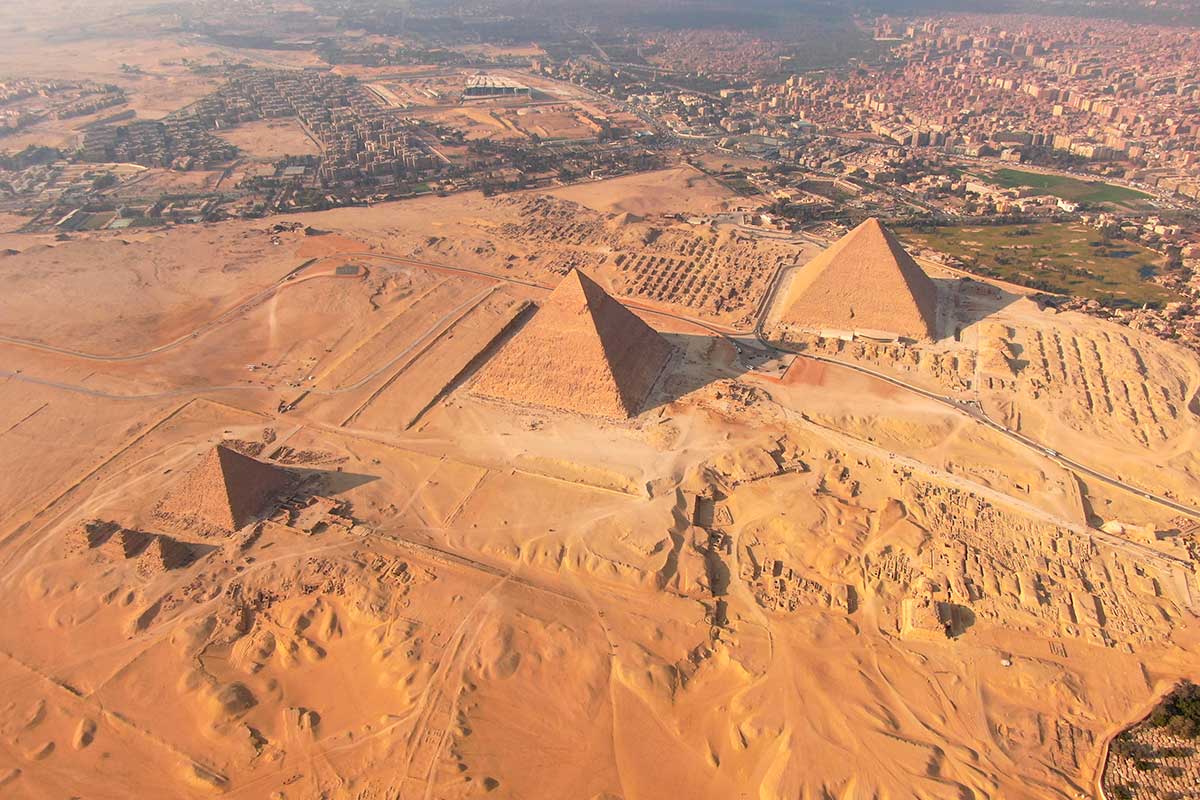
The past of Giza inevitably takes us to Ancient Egypt, a time when its name earned a place in history. Although in reality, in that period it was not a city as such, but a necropolis located in what we currently know as the Plateau of Giza. But it was not just any necropolis, but nothing more and nothing less than the place chosen for the eternal rest of the IV dynasty of the Old Kingdom, which reigned in Egypt between 2600 and 2500 BC, approximately.
That dynasty belonged to some of the most important pharaohs of that civilization, in terms of centralization of power, domain of the territory and mobilization of economic and human resources. By then, the capital was Memphis and there was nothing here. But for some reason, Pharaoh Cheops (often also called Khufu) thought that this small plateau, which rises majestically above the Nile Valley at an altitude of about 915 meters above sea level, was a good place for his great funerary project : the largest of the pyramids of Egypt, and also the most perfect ever built.
And so he achieved it, as can be seen today, although the looting and the reuse of its stone ashlars for other constructions have made it lose a bit of its splendor and height. Keos was followed by other pharaohs, mainly Kefrén (also called Khafre) and Micerino (or Menkaure). Each made their contributions, forming what we know today as the pyramids of Giza, as well as the Great Sphinx of Giza, which was probably made in the times of the aforementioned Kefrén. But there are also pyramids of queens, mastabas of priests and many other constructions, which we review in detail below.
After the V dynasty (c. 2500- c. 2350 BC), the necropolis of Giza continued to be respected as a funerary space and there are constructions datable in this period, but it ceased to be the favorite burial area for the pharaohs, who preferred other necropolises in places like Saqqara or Abusir. In addition, for long periods it fell into abandonment, without a minimum of maintenance that would free it, at least, from layers of sand deposited for centuries.
In the New Kingdom (c. 1550-1069 BC), on the other hand, sensitivity for the ancestors was recovered and important additions or modifications were made in the surroundings of the Giza pyramids, by pharaohs of the XVIII dynasty (c. 1550-c. 1295 BC). For example Thutmose I, Amenhotep II and even Tutankhamun, despite the fact that all these monarchs already had the habit of being buried in the Valley of the Kings of Thebes (present-day Luxor).
Recent discoveries have also revealed the use that was given to it in the Late Period or Late Era (c. 664 BC-c. 332 BC), when it was no longer a tradition to build pyramids in Egypt. Especially during the XXVI dynasty (664-525 BC), the last one considered Egyptian and reigning before the Persian conquest. For example, polychrome sarcophagi probably belonging to priests of that period, which makes clear the religious and funerary symbolism of Giza for the local clergy, who wished to remain emotionally connected with the ancestors who had preceded them 2,000 years ago.
The epilogue of the Egyptian civilization necessarily meant the end of the necropolis of Giza as such, without the successive dominators, whether Copts, Romans or Byzantines, using it for funerary purposes. However, the fame of the pyramids of Giza was already evident, as the Greek writer Antipater of Sidon cited them as one of the main monuments of his time (2nd century BC), in what is considered a precedent of the list of the Seven Wonders of the Ancient World.
However, it was the Arabs who, later, founded the city of Giza, understood as a settlement in which to live, therefore different from the function that the pyramids of Giza as a necropolis had had. They did so in the mid-seventh century AD, after the conquest of Egypt by General Amr ibn al-As, who surrendered the nearby Babylon Fortress (see History of Cairo) around 640. And it was the new Islamic settlers who probably gave the current name to this population: al-Jizzah.
In any case, it was always rather a settlement of country houses, being the neighboring Cairo (at that time, formed only by the settlements of al-Fustat, Al-Askar, Al-Qatta’i and, finally, Al-Qahira or Cairo) which monopolized all the great investments of the different rulers of the country, as it soon became the capital. And the plateau of Giza was, rather, a place from which to draw materials for different Cairene constructions, as happened with other pyramids of Egypt. Some caliphs also made modifications to the pyramids of Giza, such as Al-Mamun in 820, who created an opening to enter directly into that of Cheops.
The boom in Egyptology that emerged in the 19th century and the development of new railway transport systems promoted tours to the Giza pyramids. In fact, a tram was created that connected Cairo with the necropolis, crossing the fields that at that time dominated the terrain. And that layout served as the basis for the current highway (Al-Haram).
The growth of Giza accelerated exponentially in the second half of the 20th century, when the demographic pressure of the Egyptian capital forced many citizens to look for new housing solutions on the other side of the Nile River. A time of rampant development that raised countless blocks of houses to accommodate the growing local population, which caused the green areas that previously dominated the terrain to practically disappear. Of that, only some isolated exceptions remain, such as the Mahmoud Khail Museum, which we discuss below.
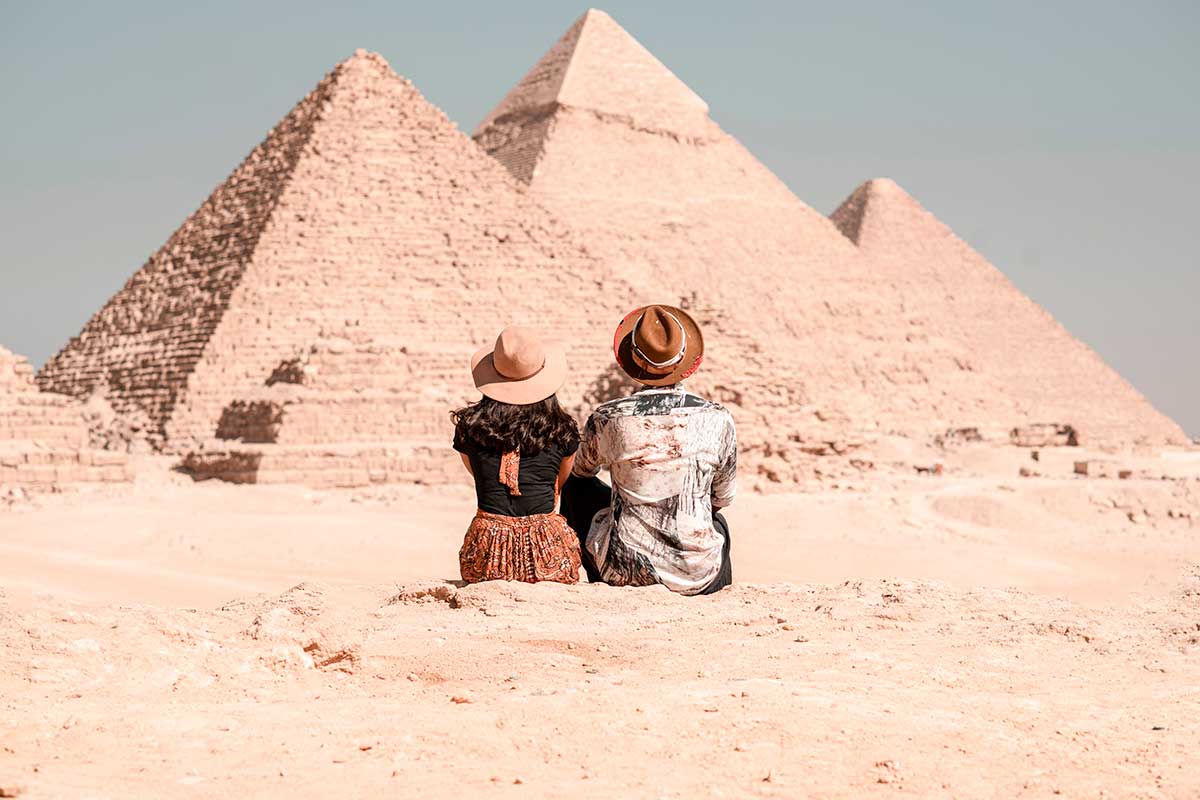
There is no doubt that the Giza pyramids put this city on the international tourist map. Therefore, the necropolis of which they are part is its main place of interest. Below we show you, one by one, the most outstanding elements of this macro funerary complex, also called Plateau of Giza.
Very numerous were the pyramids of Egypt Ancient. And although many of them have been lost, many are still counted today: more than a hundred in different states of conservation. However, the most famous are, without a doubt, the pyramids of Giza, which are also among the best preserved.
And not by chance: technically, the pyramids of Giza are those that are considered ‘perfect‘. As we explain on the page dedicated to Architecture in Ancient Egypt, the pyramids of Egypt were the evolution of the funerary mastabas. The truncated pyramid shape of these mastabas gave way to the stepped pyramids, such as that of Zoser, in Saqqara. Later, the bent pyramids were erected, more ‘successful’, with outer faces in decreasing slope towards the summit. And finally, the perfect pyramids, with ashlars millimeter-perfectly coupled together to create four sides of totally smooth surface to the top.
As we said, at present we can hardly imagine this fact, since the outer limestone cladding was dismantled to use the ashlars in other later constructions in Cairo. Only a little of this outer cladding is preserved in the pyramid of Kefrén, at the top, and in some very specific points of those of Cheops and Micerino.
Let us remember that the pyramids of Giza, like all the pyramids of Egypt, are funerary constructions. Their practical objective was to contain the tomb of the pharaoh, in the case of the most monumental, and of the queens or other important figures, in the case of the smaller ones. And on a symbolic level, they served to contain the essence of said character, preserving it for eternity and facilitating its ascension to heaven to transfigure into the form of a star and, with it, achieve true immortality.
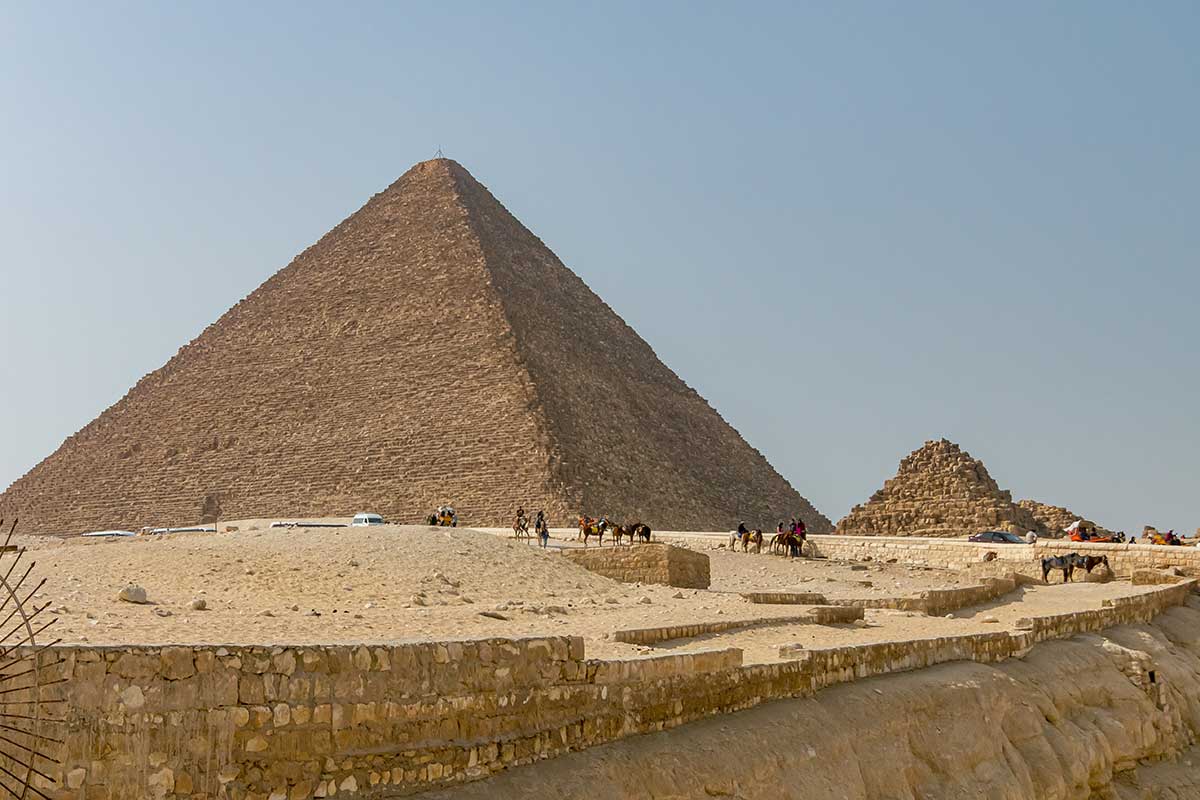
It was the first of the three pyramids of Giza and the one that led this plateau to become the necropolis that we know today. It is not known for certain why Cheops (pharaoh from 2589 to 2566 BC, approximately), discarded Dashur as his burial place, as his predecessor and father Senefru had done, who had the Red Pyramid built. Among these reasons may be the natural elevation of this plateau, which gives it great prominence from the Vega del Nilo. Or the best technical conditions for construction, for example for the supply of limestone from Tura, or the greater firmness of the terrain.
His data speak for themselves. At present, it has a height of about 138 meters, although at the time it exceeded 146 meters, thanks to its limestone cladding . Its square base is about 230 meters on each side, so it was the largest and tallest of all the pyramids of Egypt until that date. And probably no other surpassed it, although it is discussed whether that of Djedefra, now in ruins in Abu Roash, did so.
It is estimated that about 2.3 million stone blocks were used, with about 27,000 ashlars for the external cladding. It is believed that the architect responsible for this pyramid was Hemiunu, who was also chaty (vizier) of the pharaoh Khufu. These are the main elements of the project, in the pyramid itself or in its immediate surroundings:
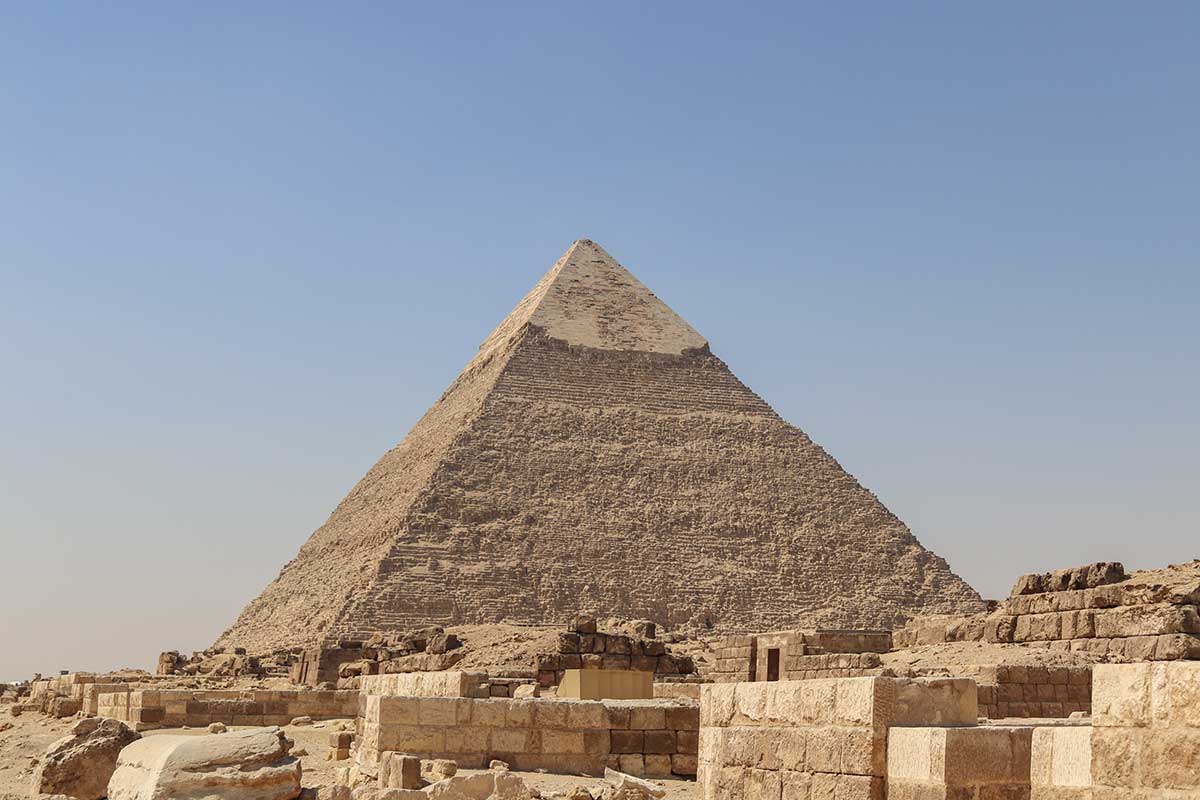
Khafre was one of the many sons of Khufu and, like his father, promoted his own funerary complex in Giza, with a pyramid as its central element. For reasons that are unknown, he decided not to surpass that of his father in height and dimensions: at present it is about 136 meters high, although originally it was about 143 meters, while its sides have a length of about 213 meters. This means that, although it is hardly noticeable, its angle of inclination is greater.
However, due to the optical effect and being located on slightly higher ground, this seems to be the highest of the three pyramids of Giza. It is the one in the center and you will also recognize it because it retains a small layer of cladding at the top.
But, like the other pyramids of Egypt, this is ‘only’ a part of the funerary complex of Khafre, which is actually composed of the following elements:
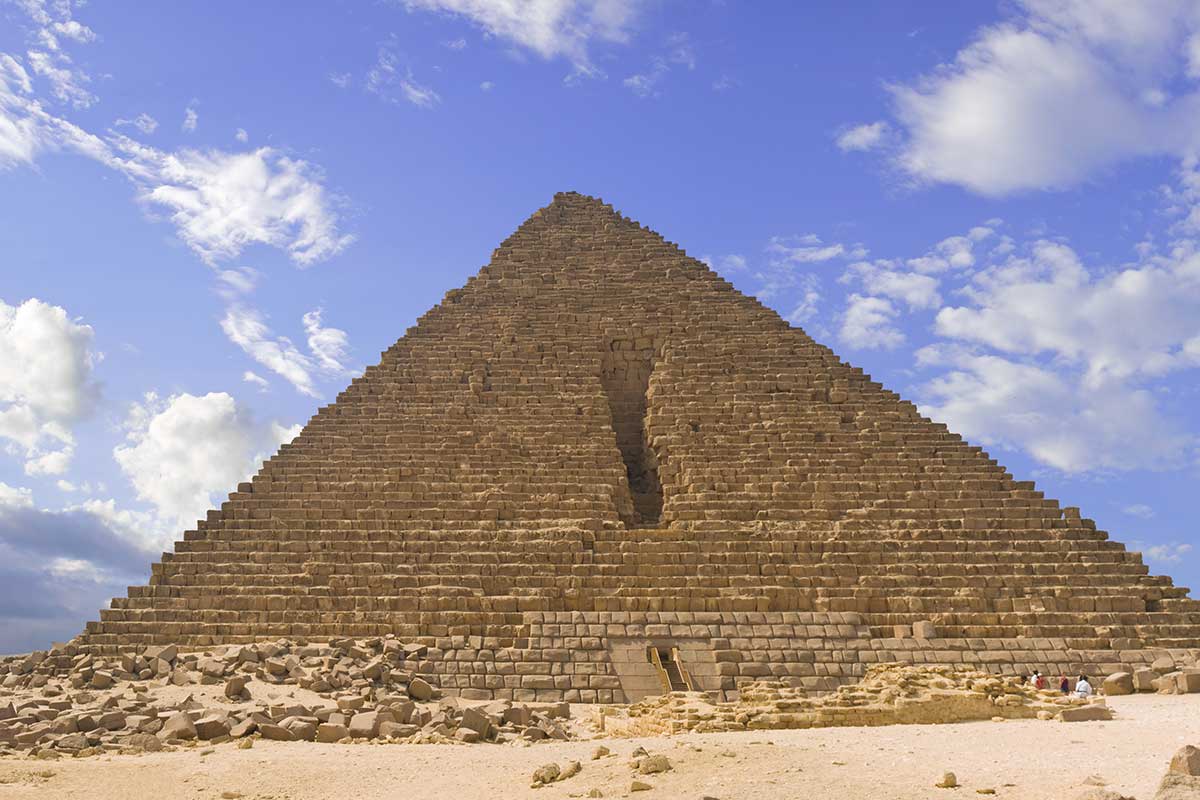
It was promoted by Menkaure (pharaoh between 2514-2486 BC), son of Khafre and, therefore, grandson of Khufu. It is the smallest of the three pyramids of Giza, and many Egyptologists consider it a sign that the power of the pharaoh was in decline, now with less capacity to mobilize economic and human resources for its construction. But despite being the smallest, its dimensions are not negligible compared to many pyramids of Egypt: base sides of 102 and 104 meters, with an original height of 65 meters. At present, the top is about 61 meters high, due to the loss of cladding.
This cladding was made with rows of two types of stone: pink granite from Aswan and white limestone from Tura. Some ashlars are preserved at the base of the latter. A large gash can also be seen on the north face, inflicted in the 12th century by the son of Saladin, Othman ibn Yousef, to try to dismantle it, although he did not succeed.
It follows a scheme similar to that of the other two pyramids of Giza, with the following elements related to:
Interior of the pyramid: like most pyramids in Egypt, the funerary chamber is below ground level, which is easily accessed. The archaeological explorations of the 19th century found a basalt sarcophagus, with a wooden coffin inside and a mummy inside this coffin. However, both coffin and mummy were of some important person from the Saite period (dynasty XXVI), both preserved in the British Museum in London. The sarcophagus, probably, was from Menkaure (although decorated in a later period). But its whereabouts are currently… at the bottom of the sea, off the coast of Cartagena! There the British ship that transported it to England in 1838 shipwrecked
In addition to all the detailed elements, there are other pyramids in Giza that are related to each of the three funerary complexes. They are smaller, but fulfill the same function. They are as follows:
In addition, there are several cemeteries scattered throughout the necropolis of Giza, composed of different mastabas or tombs. It is worth noting:
In addition to all these funerary constructions, there are remains of other spaces related to the project, such as workers’ warehouses and quarries.
Special mention deserves the Grand Egyptian Museum. Although it is not located exactly in the necropolis, but about 2 km from the pyramids of Giza, it is a new museum that is closely linked to it. It is a huge and modern construction, with an area of about 50 hectares, with 40 meters of height and 800 of length, which aims to exhibit in a more adequate way a good part of the treasures found in the pyramids of Egypt or in sites of other cities.
It is, without a doubt, the Egyptian government’s biggest bet to promote quality cultural tourism in the country, aware that the Egyptian Museum in Cairo had long since become too small. Therefore, some pieces from the collection of the Grand Egyptian Museum come from it. However, the bulk of the collection is nourished by warehouses and museums in other cities of the country, such as Alexandria, Luxor, Assiut, Sohag, Beni Suef or El Fayum.
The Grand Egyptian Museum of Giza (Grand Egyptian Museum or GEM) began to be built in 2008 and from the beginning its international magnitude was understood: more than 1,500 projects were submitted to the competition from more than 80 countries! The Irish studio Heneghan Peng won, developing a spectacular work that is composed of:
The catalog of the collection is composed of between 50,000 and 100,000 pieces, according to different estimates. The great jewels that no visitor can miss when visiting the Grand Egyptian Museum of Giza are:
Although Giza is known for having the most spectacular pyramids of Egypt, in this city there are also other plans for tourists of different types. In fact, alternative proposals to the Egyptology that permeates the Giza pyramids and the bustle of the vibrant capital of the country are concentrated here. A kind of ‘third way’ that will appeal, above all, to those traveling as a family, since it has attractive places for children, to enjoy without haste and from a more playful point of view. We review them below.
As is the case in every self-respecting tourist destination, a theme park cannot be missing. And in the case of Giza, the star theme cannot be other than Ancient Egypt. That is the setting of this small enclosure located next to the eastern bank of the Nile, opposite Jacob’s Island. It is mainly aimed at younger children, who will be fascinated by the decorations of the enclosure and, above all, by the characterization and clothing of the actors and monitors.
Activities and performances are organized in which pharaohs, queens, priests, and members of the court are the protagonists. Other proposals are aimed at older youths, such as escape rooms with mummies. Children’s workshops, parks, and even a playful cruise on the Nile are some of the options that are also in the catalog of this small theme park in Giza.
However, if what you are looking for is an amusement park with more intense emotions, the best option for Cairo residents and tourists is Dream Park, located on the other side of the Giza pyramids, about 25 km from the left bank of the Nile. It is here that you will find the classic roller coasters, water descents, and rotating structures. There are also small trains, merry-go-rounds, and other proposals for the little ones, making up a list of approximately fifty attractions. Its enclosure has an area of about 150 hectares and a capacity for more than 3,000 visitors per day. It has dining areas and commercial stores.
Another classic of family tourism in the metropolitan area of Cairo is the Giza Zoo. Located very close to the bank of the Nile, at the height of Rhoda Island, it can boast of being the largest zoo in all of Egypt. And in addition, it is a space that fulfills the function of a green area of more than 30 hectares, so walking through it is a good option to escape the suffocating heat.
As far as its origins are concerned, the Zoo of Giza can be considered one of those projects that placed the area of Cairo at the level of the great cities of Europe and the West, promoted by the Khedive Ismail at the end of the 19th century. And good proof of this is the iron bridge designed by Gustave Eiffel.
Regarding the fauna of the Giza Zoo, there are more than 175 species and approximately 6,000 specimens. Native breeds are of particular importance, especially in the reptile section, such as the Egyptian cobra (Naja haje), famous because it is believed that Cleopatra used its venom to commit suicide, so it is also known as Cleopatra’s asp. In addition, it was a very symbolic animal for the pharaohs, as it represented the goddess Uadyet, whom they invoked with a uraeus at the height of the forehead, visible in the funerary masks.
Migratory birds also have a very prominent role here, such as flamingos or ibis. The list of species is extensive and includes some strongly associated with Africa, such as large felines (lions), giraffes, and rhinoceroses, among others.
A similar respite to the Zoo of Giza is offered by the adjacent Orman Garden, the botanical garden of reference for the entire metropolitan area of Cairo. And in fact, it was created almost at the same time as the aforementioned zoo: promoted by the Khedive Ismail at the end of the 19th century, as part of the garden of his palace. With a few hectares less than its neighbor, it is organized into areas of different characteristics, such as the rockery (rustic and rocky style), the rose garden, or the cactus garden (cactarium).
But the most emblematic place is, without a doubt, its lotus plant pond, a natural space closely linked to the culture of Ancient Egypt, as a symbol of purity, of birth on the waters of the Nile, and of the invocation to the god Ra, since the petals of its flower open when receiving the rays of the sun.
The University of Cairo is the great institution of higher education in the ‘Western’ style. And it arose precisely as a modern equivalent to the religious University of Al-Azhar (madrasa), a center of Islamic education that some consider the oldest in the world and that still enjoys international prestige today, as we tell you on the page dedicated to Cairo.
This one, on the other hand, arose at the beginning of the 20th century and although it has the ‘surname’ of Cairo, it is in the city of Giza. Its main campus occupies a huge space next to the zoo and the botanical garden, highlighting in its access the central administrative building, with a huge dome. It has about twenty faculties, among which we can mention the Faculty of Medicine, the Faculty of Law, and the Faculty of Archeology.
From an artistic and tourist point of view, one of the elements most recognized by Cairo residents and visitors is the sculpture Renaissance of Egypt, a work by the artist Mahmoud Mukhtar, the most important in the country in the 20th century. It is located in a strategic place, next to the beginning of the Cairo University Bridge, between the botanical garden and the zoo, and in perspective with the aforementioned university dome in the background.
Cairo University should not be confused with New Giza University, which is private and of much more recent foundation, as it began its classes in 2016. This one, in addition, is located in another area: the exclusive area of New Giza.
It is one of the few 19th-century mansions that are preserved in Giza and that allow us to imagine what this area was like until the demographic boom of the late 20th century filled everything with blocks of houses. It is named after an Egyptian minister of the 1930s who, in addition to being a politician, was a great collector, especially of Western modern art. Therefore, the collection that is exhibited here can be considered one of the best of its kind in the metropolitan area of Cairo and throughout Egypt in general.
The list of artists with a presence in the catalog is dazzling and includes the sculptor Auguste Rodin and the painters Corot, Pisarro, Millet, Renoir, Sisley, Monet, Gauguin, Degas, Toulouse-Lautrec, and Van Gogh, in the latter case with a series of paintings of lilies that is the great attraction for its visitors.
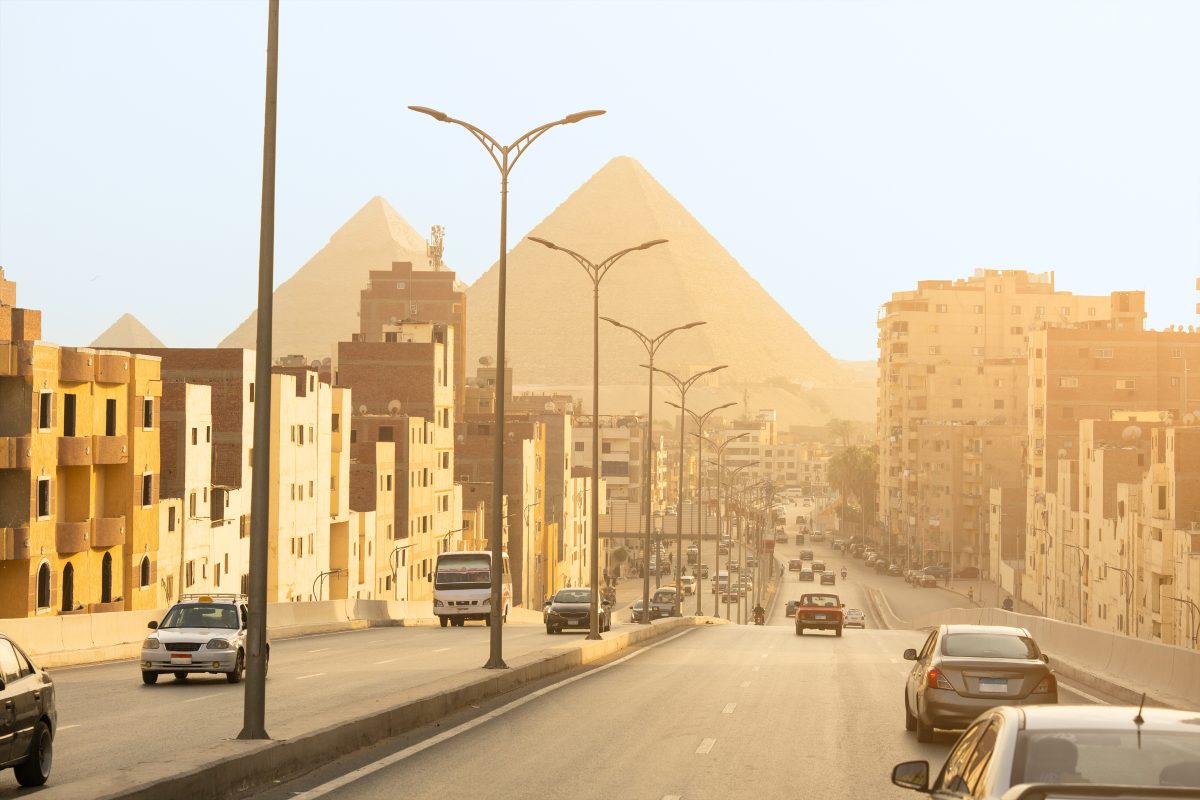
The tour to the Giza pyramids is that essential excursion that all travelers from Cairo must take. And for many, it is the main reason for their trip. If that is your case, you can consult the information on how to travel here from the Cairo page, since you will most likely have to land at the airport in the Egyptian capital. However, the inauguration of a new airport, the Sphinx International Airport, is planned soon, which aims to serve Giza and all of West Cairo.
On the other hand, if you are going to spend a few days intensely discovering the Giza pyramids, its necropolis, and the other attractions explained about this city, it will be very useful to take a look at the following section.
When it comes to accommodation, you have two great options: choose a place in the vicinity of the Giza pyramids or opt for Cairo. In the Egyptian capital, there is greater variety, as you can imagine, but the hotel offer located next to the necropolis is also of high quality. For example, several international chains have a presence in the area between the Giza pyramids and the Grand Egyptian Museum, so it can be considered an interesting option for travelers whose priority is to visit both places.
Further west is New Giza, an exclusive residential area that houses some of the most modern facilities in the metropolitan area of Cairo. To the aforementioned university of New Giza is added the golf course, international schools, luxury hotels, and other high-level accommodation solutions. Therefore, this may be a good choice for travelers looking for the highest standards of quality.
With regard to transport, getting around Giza may not be very comfortable if you rely exclusively on public transport. Metro line 2 runs through a part of the city, with several stops such as El Bohoos, Cairo University, Giza, Sakkiat Mekki, and El Monib. However, this can be considered only a solution for trips near the western bank of the Nile, where the zoo, the botanical garden, the university, and the Pharaonic Park are located.
However, the Metro is not an option to get to the Giza pyramids from other points of the city or from the center of Cairo, as it is very far away. The solution would be the bus from the center of Cairo (lines 355 and 357), but it is not the most comfortable and recommended option either.
In this sense, the most successful means of transport is the taxi, preferably the white ones, as their vehicles are more modern and comfortable. For the rate, you can take as a reference what is stated on the Cairo page: the standard rate will cost you LE 2.50 for the flag-down and LE 1.25 per kilometer. And we remind you that in recent times pink taxis have emerged, driven by women and aimed at female travelers, as a gesture of trust and security.
At the foot of the Giza pyramids, next to the access control point and the Mena House Hotel, you will find a tourist information office, where you can find information about visits to the necropolis, the Grand Egyptian Museum, and the rest of the city’s attractions. However, given the geographical link between Giza and Cairo, in the offices of the Egyptian capital you will also find information about the Giza pyramids and the rest of the neighboring attractions.
Finally, we remind you that if you wish, Egipto Exclusivo can provide you with the best services in transport, accommodation, and information. For transport, private taxis and minivans with a driver so you don’t have to worry about any travel. Accommodation, so you can stay in a hotel or villa that meets your expectations. And information, with the best guides so you can fully enjoy each visit. Get in touch and don’t miss any detail of the most famous pyramids of Egypt.


