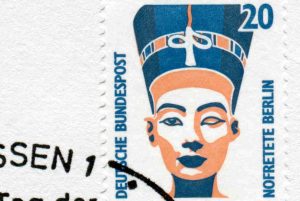
For many, Nefertiti and her bust are the most widely recognized image of Ancient Egypt, rivaled only by the Pyramids of Egypt and Tutankhamun’s mask. For this reason, we have dedicated several posts to her on this blog, and she continues to feature in online publications, newspapers, television, and more, thanks to ongoing discoveries about her. However, there are still things about her that remain unknown or are not as widely known. In this post, we review some of them.
What we do know and have already told you
To recap, it is worth recalling the most notable facts about her life: she was the wife of Pharaoh Akhenaten, who revolutionized the country and its religion through the worship of the solar disk, later considered heretical. She was therefore Tutankhamun’s mother and must have exerted a special influence on him after becoming a widow. In fact, in recent weeks, the theory we previously discussed about her missing tomb has resurfaced: it could lie in a hidden chamber inside Tutankhamun’s tomb.
As for the bust, the true reason for Nefertiti’s fame, we remind you that it is in the Neues Museum in Berlin. It left Egypt in 1912 and is currently being claimed by the country. Some 3,000 years after it was created, the bust is still considered a true ideal of feminine beauty.
What you may not know about Nefertiti and her bust
Although you may have seen Nefertiti’s bust thousands of times, have you paused long enough to notice some interesting details? Undoubtedly, one of the most striking features is the absence of her left eye. At first, it was thought to have fallen out, but later studies proved otherwise: the sculptor Thutmose, who created the work, never inserted a quartz eye as he did in the right socket. The reason? A complete mystery, which adds even more to its aura.
Some believe it may be an unfinished work; others argue that the sculptor used this bust, made from a limestone core coated with stucco, to teach his pupils the craft. Some even believe that Nefertiti may have been blind in one eye, although other depictions of the queen show both eyes.
Another key detail is the headdress she wears, known as a modius: an especially elongated hat or crown in dark blue. This attribute is thought to be associated with fertility, of which the queen was a symbol, having also been the mother of six daughters. Notably, the elongated modius echoes her long neck, creating a particularly graceful appearance. Her full, well-defined lips and eyes outlined in black in the style of Egyptian kohl makeup emphasize her feminine character.
Her husband, Akhenaten, was also often depicted with feminine features, such as a protruding belly, wide hips, a wasp waist, or a slender figure. This may be associated with the so-called “Amarna style,” named after the capital from which they ruled (ancient Akhetaten). But what is striking is not this, but the fact that Nefertiti appears to occupy a level of importance comparable to her husband’s, which would support the idea that Nefertiti played a prominent role at court and in religious life.
In any case, Nefertiti’s presence in modern-day Egypt is limited, as few works depicting this queen have survived. Among the few that exist, notable examples include a relief depicting her worshipping the solar disk alongside her husband Akhenaten and an unfinished bust, both in the Egyptian Museum in Cairo (in Tahrir Square).