
The traveler has much to see in Luxor.. Therefore, dedicating only one day to visiting it is clearly insufficient.. Some of the most interesting places in all of Ancient Egypt are located here! Examples of this are the Luxor Temple, the Karnak Temples, the Valley of the Kings of Egypt, the Temple of Hatshepsut, or the Ramesseum, among others. Therefore, on this page we explain everything you need to know about this city and its archaeological remains, the true epicenter of modern Egyptology and a must-see destination for those taking a Nile cruise, before, during, or after embarking on it.
And if you need an expert agency to organize every last detail of your trip so that everything goes perfectly, do not hesitate to contact Egipto Exclusivo. We will provide you with the best services, from accommodation to transportation, including restaurants and guided tours of the monuments to see in Luxor.
In Luxor, as in practically all of Egypt, there may be a slight confusion of terms. This is due not only to the change of language but also to the different alphabets used to name the places: hieroglyphic, hieratic, demotic, Arabic, Greek, Latin… In addition, we must add that the names that the Egyptians themselves gave to their places differ from those that the Greeks gave them later. In the Western world, it is common to use the name given by the Greeks, perhaps because it is simpler or more familiar.
Finally, the variety of places of interest for tourist destinations means that geographical terms are sometimes confused. Therefore, from now on you must be very clear about the following terms:
On this page we tell you the most interesting things to see in Luxor and we use this name because it is the current city and the most widespread term at a tourist level. But when we refer to the civilization of Ancient Egypt, we will also use the name ‘Thebes’ or ‘ancient Thebes.’
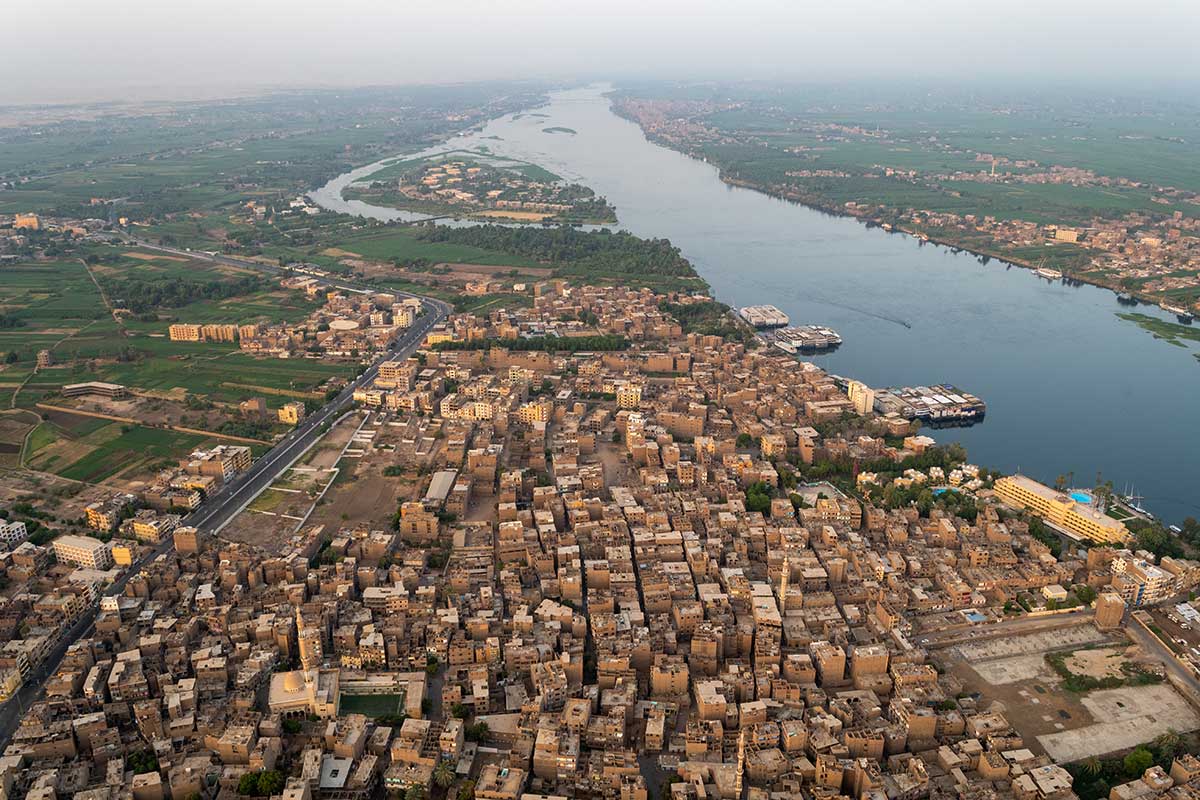
A fundamental question that has to do with Luxor is its climate, which is conditioned by its geographical location. This city is located in Upper Egypt, about 650 km south of Cairo, which is equivalent to about 7 and a half hours by car from the Egyptian capital. Located on the banks of the Nile, the inhabited surface corresponds to the fertile plain of the river, which occupies about 5 km on each side and in a straight line from the bank.
Beyond this plain, the most arid desert opens up: to the east, the Arabian or Eastern, and to the west, the Libyan or Western. Therefore, despite the course of the Nile, the climate of this city is typically desert. Its classification is BWh, like the rest of the country, but here its characteristics are much more pronounced than in other parts of Egypt, such as the Delta or the coasts. These are the meteorological values of the city:
For practical purposes, what you should know is that the central hours of the day can be suffocating, especially in summer. If you are going to make your trip at that time of year, we recommend advancing in the morning or delaying in the afternoon everything you have to see in Luxor, dedicating midday to replenishing your strength or taking a refreshing dip in your hotel pool.
You can also schedule some visits to air-conditioned spaces for that time, such as the city’s museums (see section ‘Museums to see in Luxor’) or visit the interior of the Valley of the Kings, whose hypogea can be a good refuge against the heat, although the air inside is not exactly fresh, at least it serves as shelter against solar radiation, so extreme when the sun is high in the sky.
Until the year 2,150 BC, Thebes was a small town, a reference to its nome, that is, the portion of cultivable land in which it was framed. By then, its weight in Ancient Egypt was not remarkable, nothing to do with other previous capitals, such as Memphis, Tinis, or the nearby Hieracómpolis. Its temples must have been relatively small and dedicated to local divinities, such as Montu, Mut, and Amun. You will not find any of them on our list of proposals to see in Luxor, because nothing of them has remained.
However, something began to change from that date. The country was strongly divided territorially, without a pharaoh who exercised a common dominion as had happened in previous centuries during the Old Kingdom. And the nomarchs of Thebes began to show a greater military vigor that led them to progressively subdue the neighboring nomes, expanding their dominion to the south and to the north, until they subdued practically everything we know today as Egypt.
It was the so-called Eleventh Dynasty (c. 2150-c. 1990 BC), among which Menthuotep II, Menthuotep III, and Menthuotep IV stood out, architects of a new reunification of Ancient Egypt. This period is known as the Middle Kingdom, and Thebes was its new capital. Therefore, the city began to grow in size and splendor.
Greater impetus was still received with the following dynasty, the XII, continuator of the previous one, which initiated some of the most important constructions to see in Luxor today. In particular, the Karnak temples, which began to be built under the reign of pharaohs such as Sesostris I, who erected the White Chapel, now reconstructed with its own stone blocks. It is a time in which the city not only grows quantitatively but also symbolically, since its temples and divinities begin to become references for the rest of the territory. In particular, Amun, who will be assimilated with the solar god Ra to become Amun-Ra, and who was worshiped in the aforementioned Karnak enclosure.
With the fall of the Twelfth Dynasty, a new period of turbulence and division opened, the Second Intermediate Period (c. 1750-c. 1550), in this case caused to a large extent by the invasion of the Hyksos. However, the local Theban governors (Dynasty XVII, contemporary to those of other areas of the country) played a fundamental role: from here they rearmed militarily to expel the invaders and reunify, once again, the country with Thebes as its capital.
In this way, the dynasties XVIII, XIX, and XX starred during the New Kingdom (c. 1550-1069 BC) the period of greatest splendor for the city. And with it, the construction of the main monuments to see in Luxor today: the Valley of the Kings of Egypt, the temple of Hatshepsut, the temple of Luxor, etc. And also, the temples of Karnak were considerably expanded , which with each new Egyptian military conquest saw its enclosure grow, as a divine thank you from the pharaohs.
But in parallel to the splendor of ancient Thebes, the importance of the clergy of Amun was growing within it. Their influence even conditioned the pharaoh, l or which led to the schism of Akhenaten or Amenophis IV (dynasty XVIII) in the Amarna Period. This pharaoh decided to abruptly end their benefits, privileges, and quotas of power: he established the monotheistic cult of the solar disk Aten, moving his residence and capital to the new city of Akhetaten, in the current Tell el-Amarna.
After his son Tutankhamun and, above all, from the first Ramesside dynasty (the XIX), the polytheistic cult and the religious importance of Thebes were restored, although the capital was moved to a new city founded by these pharaohs: Pi-Ramesses, in the Nile Delta. In Thebes, on the other hand, the high priests of Amun remained as effective rulers, some of whom even held the title of pharaoh during dynasties XXI and XXII. So, although Ancient Egypt and Thebes had already entered the less splendid Third Intermediate Period (1069-747 BC), the clergy of Amun and the local rulers continued to embellish the city and its temples, also leaving interesting details to see in Luxor today.
Thebes remained as a spiritual center until the end of this civilization, overcoming the mistreatment and abandonment of the subsequent Persian invaders. This is demonstrated, for example, by the visit to the city of Alexander the Great during his stay in the country, after his victory over the Assyrians. A visit that he made coincide with the Festival of Opet, which was celebrated here. Therefore, the Hellenic emperor, crowned as pharaoh, reconditioned some elements of the Luxor Temple.
In the line of Alexander the Great, the first Ptolemaic monarchs showed similar respect for the sacred precincts of the city: the Luxor Temple and the Karnak Temples. However, the continuity of Egyptian worship was lost during Roman and Byzantine times, causing the city to lose its vitality. The Luxor Temple, in fact, was partially converted into a Christian church at the end of the 4th century AD. And some tombs in the Valley of the Kings of Egypt even served as a refuge for Coptic hermits.
Towards 640, after the dazzling conquest of Egypt by the Arabs, there were also important changes in the city and in its sacred precincts. Aware of the historical and symbolic importance of ancient Thebes, they gave it a new name based on the remains that remained of it. And from this derives the current name: al-Qusur (‘The Palaces’), in reference to the Karnak Temples and the Luxor Temple. However, it did not recover its past splendor and remained a humble town built on the ruins of the glorious Theban capital.
And when we say that it was built on the ruins of ancient Thebes, we are not speaking figuratively: the most significant places of that city were gradually buried under a layer of sand deposited by the desert winds, almost completely covering the original constructions… fortunately for those who visit them today, because that helped the excellent state of conservation of the monuments that are to see in Luxor today.
In any case, the new Arab inhabitants went further and, as can be seen today, occupied part of theLuxor Temple to build the mosque of Abou Al Hagag, in a unique combination of elements from both periods, where minarets and pylons are mixed in a whole. The name of this mosque evokes Sheikh Yusuf Abou Al Hagag (13th century), a sacred figure and considered a descendant of Muhammad through his daughter Fatima. And since he was buried here in the 13th century, his mawlid or birthday began to receive solemn and annual commemoration.
This religious event was practically the only thing that brought some fame to Luxor during the following centuries until, thanks to the development of Egyptology in the 19th century, the world once again set its eyes on the ruins of ancient Thebes. An interest that also led to the rediscovery of the Valley of the Kings of Egypt, whose treasures were extracted at that time with an eagerness more typical of treasure hunters than of conservationist archaeologists.
An Egyptology that led to Egyptomania in the 20th century, especially after the discovery of the tomb of Tutankhamun in 1922. By then, and for the good of the country, the new findings were already swelling the collections of Egyptian museums, attracting an increasingly large number of tourists. Now, nothing has to see Luxor with that city that was losing its heritage by leaps and bounds. And in fact, since 1979 it has been a UNESCO World Heritage Site, under the title: Ancient Thebes with its necropolis.
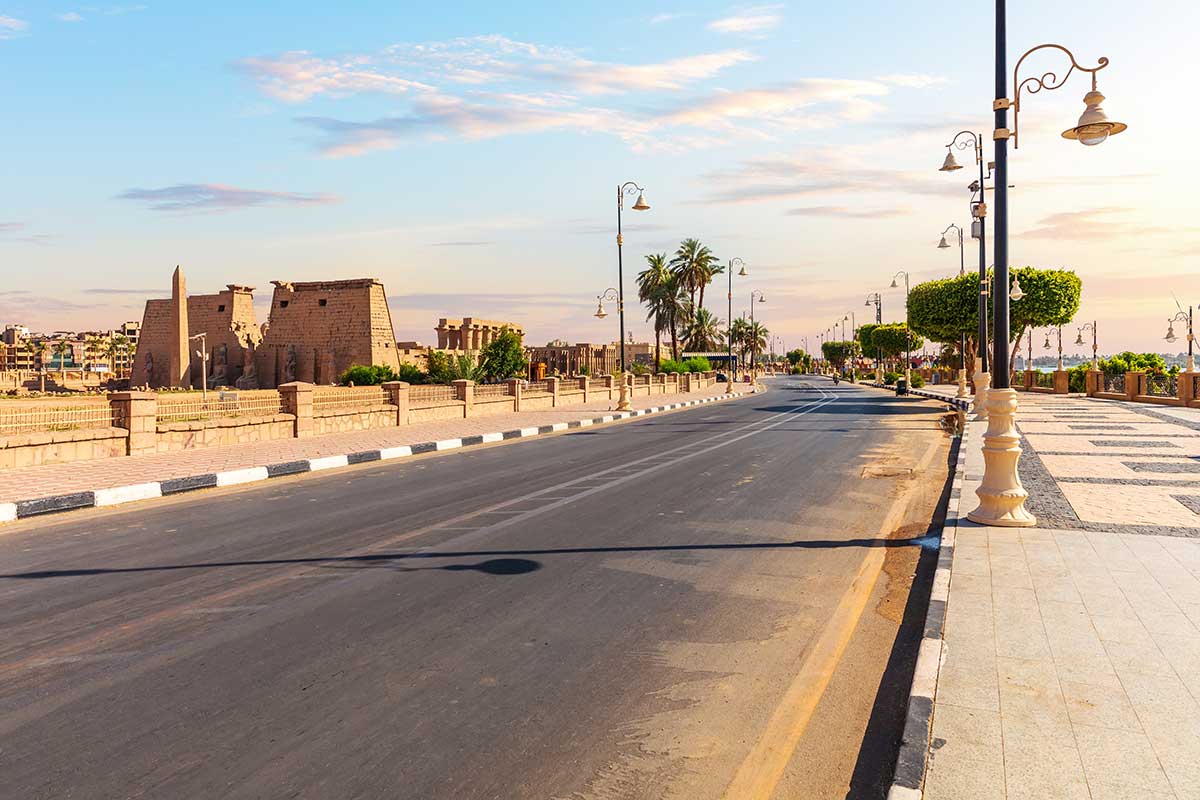
Currently, since there is nothing else to see, Luxor is a city in which the vast majority of its inhabitants, directly or indirectly, depend on the tourism sector: more than three quarters of the workforce, according to some sources. Many also dedicate themselves to agriculture, especially the cultivation of sugar cane, and it is common for many local residents to cultivate plots of land for their own benefit.
The current city has a population of approximately half a million inhabitants and has been able to take advantage of the large flows of tourists to renovate its urban center and its services, as demonstrated by the rehabilitation of its Corniche (river promenade on the eastern bank of the Nile) or the founding of a new university in 2019.
Due to the political and religious importance of ancient Thebes, it is easy to imagine that there are many things to see in Luxor. A great many. But luckily, they are not excessively far from each other. To make it easier for you to get around the places of interest, we will divide what there is to see in Luxor into two large areas:
The link between both areas is made at the height of the Luxor Temple: there you will find a ferry that, every so often, crosses the Nile from one bank to the other to transport passengers, mainly tourists. In the section ‘Practical information about Luxor’ we give you more details.
The Luxor Temple area is considered the center of the city, at least from a tourist point of view. And it also occupied the heart of the ancient Egyptian city of Thebes. Therefore, you can take it as a reference to move to the great attractions what to see in Luxor. In fact, one of the public spaces preferred by tourists and locals is the Abou Al Hagag square, which overlooks both the mosque of the same name and the aforementioned Luxor Temple. It is a few hundred meters from the train station and next to the pier from which the ferry departs to the west bank.
Therefore, your tour program can start at the Luxor Temple. And despite its strategic location, it is not a very bustling place, so you can see it calmly and at your own pace. One suggestion is to visit it at night, when the night lighting elevates its magnetism and solemnity to the maximum expression.
The first and great architect of the Luxor Temple was Amenophis III (or Amenhotep III) of the XVIII dynasty, back in the 14th century BC. He promoted it in the height of the Theban city, capital at that time of Ancient Egypt. However, it has undergone changes, with additions and losses. His monumental project, by the way, included another funerary temple on the West Bank, of which only the Colossi of Memnon are preserved.
To the interior of the Luxor Temple you will arrive by means of the spectacular Avenue of the Sphinxes, a paved road that at the time connected this building with the Karnak Temples, located about 3 km to the north. At the time it had… about 700 sphinxes! A spectacular tour that was carried out during the Opet Festival and that served as a celebration of the annual flooding of the Nile, as well as a reaffirmation of the pharaoh’s power. In that celebration, sacred images of the local triad were transported in portable boats: Amun-Ra, Mut and Jonsu). A festivity that is currently recreated, with hundreds of participants and typical clothing, which is an interesting spectacle to see in Luxor if your trip coincides with it.
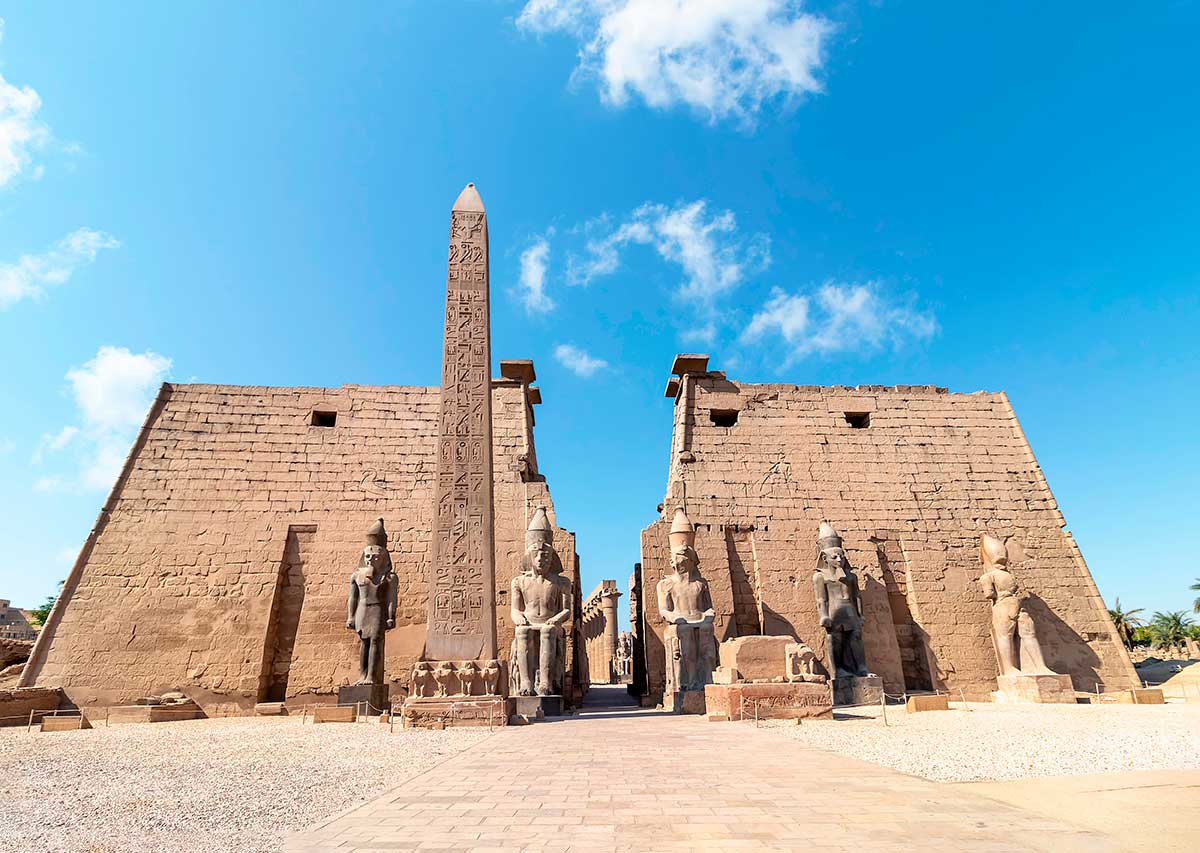
Flanked by the sphinxes that remain, you will reach the first pylon of the Luxor Temple, erected somewhat later in the times of Ramses II, on whose walls he ordered to engrave the battle of Qadesh against the Hittite empire (1274 BC). He felt very proud of it, as Abu Simbel also demonstrates… although in reality the contest ended in a draw. Not content with that, he also ordered to erect six colossal statues of himself and two obelisks. Now there are, essentially, two seated ones on each side of the entrance , as well as an obelisk (the other, by the way, is the one that stands in the Place de la Concorde in Paris).
The next space of the Luxor Temple was also ordered to be built by this pharaoh: the Great Courtyard of Ramses II, with rows of columns with papyrus-shaped capitals. There is also a space dedicated to the Sanctuary of the Barque. And it is here where the mosque of Abou Al Hagag is embedded which, given the devotion of the local people for this sacred character, it was decided to maintain in its current location after the archaeological works. And, by the way, to make it possible for this temple to have maintained a religious cult for more than 3,000 years uninterruptedly. Quite a record!
After this great courtyard, the Luxor Temple ‘returns’ to its origins, with spaces conceived mainly during the reign of Amenophis III: the spectacular processional colonnade leaves the visitor speechless due to the dimensions of its columns, with more than 20 meters in height, which probably served as inspiration for the hypostyle hall of Karnak. The Courtyard of the Sun, with rows of columns on three sides, gives way to the hypostyle hall and, this, to the interior and roofed sanctuaries.
In addition to chambers and sanctuaries, such as another of the Barque, the ‘sancta sanctorum’ is preserved, a space that only the pharaoh and the priest accessed, where the image of Amun-Ra was kept, which is no longer preserved. However, you can also see marks left by the camp that the Romans set up here at the time.
After visiting this temple, you can set off towards the other great sacred site to see in Luxor: the one that preserves the Karnak Temples. As we said, in the times of ancient Thebes it was possible to make the journey through the Avenue of the Sphinxes, but now there are several streets that break this continuity. Instead, it is common to make this journey in a northerly direction through the Corniche: the eastern bank of the Nile, conditioned as a pleasant walk from which to look out over the West Bank and access other places of interest, such as the Luxor Museum or the Mummification Museum (see section ‘Museums to see in Luxor’).
If you do not stop at them or at any of the pleasant cafes on the banks of the river, you will arrive after a long time at the site of the Karnak Temples. Assess your strength, your available time and the time of day you make this journey: if any of these factors is not the right one, you should take a taxi or a calesa (see section ‘Practical information about Luxor’, below). You can also assess the night visit, a time when light and sound shows are held.
Here, and despite not having its religious function anymore because it is in ruins, the adjectives are exhausted. Therefore, it is convenient to resort to the name that the Egyptians themselves gave to the whole: ipet-isut, translated as ‘the most perfect place’. Started by the pharaohs of the Middle Kingdom, Thebans of origin and reunifiers of the country from this city, the most significant of the Karnak Temples was erected during the New Kingdom (h.1550-1069 BC). But there are also later contributions, even by the Ptolemaic dynasty or the Roman domination, encompassing about 1,500 years of continuous construction, with numerous additions and modifications.
The Karnak Temples, in reality, were much more than a sacred space: also it was an administrative center, residence of the pharaohs and, during its construction periods, a space in which thousands of workers worked. In addition, it was the seat of the clergy of Amun, whose priests had so much influence that some of them came to adopt the title of pharaoh during the Third Intermediate Period (1069-747 BC).
As you may have noticed, we refer to the Karnak Temples in plural because, in reality, it is a complex with three enclosures: that of Amun, that of Montu and that of Mut. However, the largest, most famous and spectacular is that of Amun, which acts as a central enclosure to which the other two are connected, smaller and in worse condition, although its visit is also worth it. In total, the surface of the site is around 30 hectares, which accounts for its large size. Therefore, like the rest of the great monuments q ue to see in Luxor, you must be patient if you want to discover it in depth.
The entrance and visitor reception center of the Karnak Temples is located next to the Nile. After accessing, you will immediately find a short Avenue of the Sphinxes with ram heads. To it, at the time was reached, by means of a canal diverted from the river, through which the sacred boats sailed. Here stands the first pylon, which at the time greeted the visitor with imposing flags, although in reality it is unfinished, as suggested by the uneven height of its walls.
The next space is the Great Courtyard, in which is the small temple of Seti II, with chapels for the boats of the Theban triad (Amun, Mut and Jonsu), as well as the temple of Ramses III. Also here it is easy to see and recognize another colossal statue of Ramses II, one of the great architects of the Karnak Temples: it is prior to him but it is retouched so that it had his features.
After that, a second pylon and, after, turn for the most emblematic, most photographed and, at the time, most painted space: the Great Hypostyle Hall. It is often described as a ‘forest of columns’, but it would be more appropriate to speak of a ‘sea’ of columns’, as it probably evokes the primordial ocean of the Egyptian religion in which the papyrus plants grew, as suggested by the capitals, which adopt that form. Its figures say it all: 134 columns, between 15 meters and 21 meters high, and about 10 meters in circumference. Carved and, at the time, polychrome , these columns make the visitor feel small.
After this Great Hypostyle Hall, a third pylon from the time of Amenophis III is crossed and you reach a courtyard, to then reach the oldest part of the enclosure, from the times of Thutmose I (15th century BC). Past the fourth pylon, the obelisk of Hatshepsut, the highest in Egypt, with about 30 meters, is striking, although in reality there were others here.
From this point on, everything is more deteriorated and it is difficult to imagine the function of each space, although you can recognize a cubic construction that served as a sanctuary for the Sacred Barque. It is also easy to distinguish the sacred lake, which at the time provided water to the complex of the Karnak Temples.
Everything described follows a west-east axis, but there is another north-south axis that connects the other two Karnak Temples: Mut and Montu, outside the enclosure of Amun, and that also have several pylons. The one of Mut, wife of Amun, is the most deteriorated. At the opposite end is that of Montu, god of war, which is not always visitable.
Another of the Karnak Temples is that of Jonsu, to where the Avenue of the Sphinxes that started from the Luxor Temple arrived. Also small is that of Ptah, which is an addition from the time of Thutmose III, thus introducing the devotion to this creator god whose center of worship was Memphis. In addition, in the northern area of the Amun enclosure there is an open-air museum where you can see, among other things, the White Chapel from the times of Sesostris I (XII dynasty, Middle Kingdom, 20th century BC), reconstructed with a good part of its original stone blocks, distributed later by other points of the enclosure.
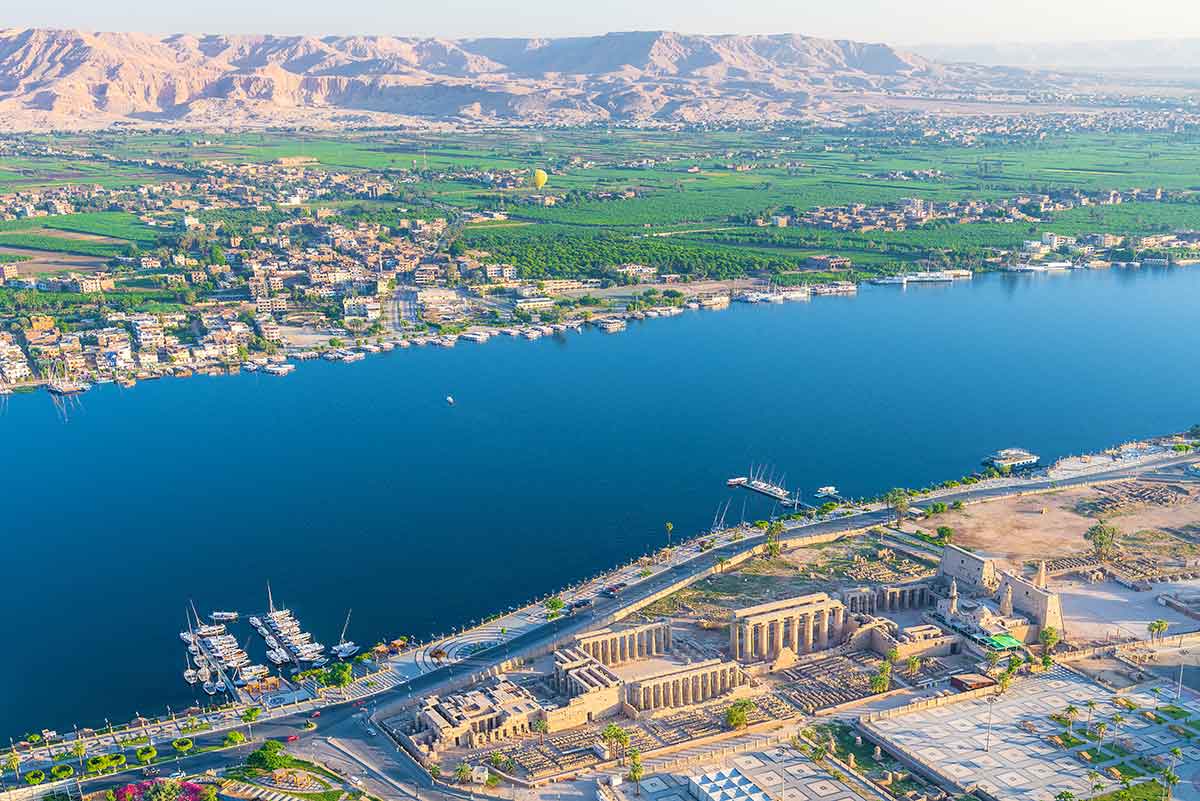
The West Bank encompasses a good part of the places to see in Luxor. It is an area of great extension, so you will need more than one day if you want to know the area without losing detail. You will arrive by means of a ferry that crosses the Nile every 10 minutes approximately, from the pier located next to the Luxor Temple. And, after leaving an area with shops, restaurants and hotels, begins a great road to the visitable area, located between the steep elevations that arise when the green cultivated fields end.
And taking into account the stifling midday heat, we give you two tips. The first is to prepare yourself to get up early: from the very early morning, the monuments can be visited, when the ambient temperature is much more pleasant. And the second is to choose the right means of transport to move around them, with the best of all being a private taxi. Walking is ruled out due to the long distances and harsh weather conditions.
As we said, many of the essential places to see in Luxor are here, so we show them to you one by one below.
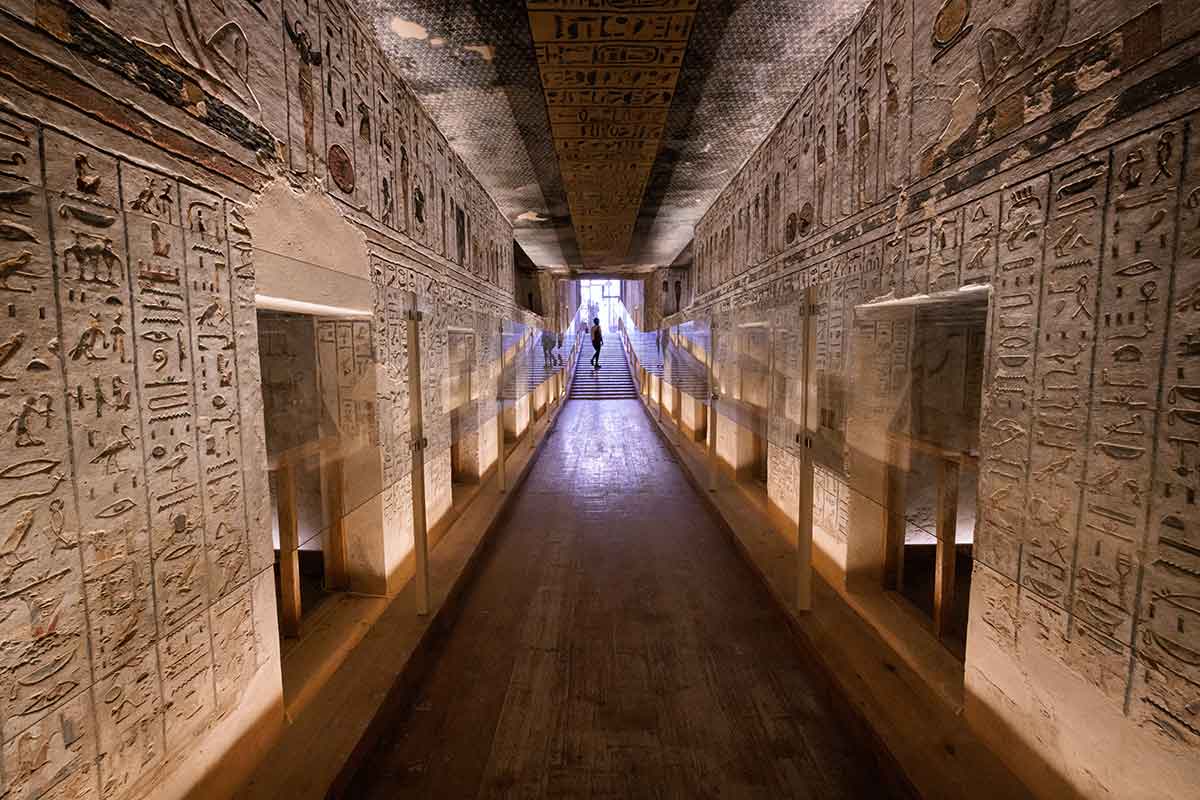
The Valley of the Kings was, together with the Temple of Luxor and the Temples of Karnak, one of the factors that consolidated ancient Thebes as the great city of its time. It was the necropolis of the pharaohs from the 18th dynasty onwards, who found here a protected and theoretically safe space for the tomb of their eternal rest, the construction of which they could supervise from the capital. And we say ‘theoretically’ because, despite the remote and inaccessible location, many tombs were discovered by looters and thieves, desecrating them and emptying them of valuables. This caused a great loss of heritage for the city , although luckily there are still many objects to see in Luxor and its museums about those tombs, as well as in Cairo and other cities, even foreign ones.
The Valley of the Kings , like the rest of the necropolis in the area and others in Ancient Egypt, is located on the west bank of the Nile, the sunset side, as Egyptian religion considered that the Duat was located there: a celestial underworld, from where Ra traveled with his boat towards the sunrise, thus making an underground journey in a west-east direction that he then made in reverse through the sky.
For all these reasons, the vast majority of the pharaohs of the New Kingdom considered the Valley of the Kings as the propitious place for their eternal rest, excavating hypogea of great complexity and decorative richness in the rock, with engravings and paintings from the floor to the ceiling, and with a funerary trousseau that receives, with all merit, the name of ‘treasure’. They dedicated numerous years of their mandate to its construction, with enormous economic and human resources.
The Valley of the Kings of Egypt was built and expanded for approximately five centuries, from the 16th to the 11th century BC. More than 60 tombs are known, with very variable sizes: from simple pits to huge hypogea with more than 100 chambers inside. However, there are still several important tombs of pharaohs that have not been discovered, which continues to encourage researchers in their search. To correctly identify all of them, the following numbering is used:
There are no two identical tombs in the Valley of the Kings , but we can indicate some characteristics common to many of them:
Luckily for today’s tourists, many of the tombs are open to visitors, so here we show you some that, due to their beauty or importance, you can add to your list of places to see in Luxor .
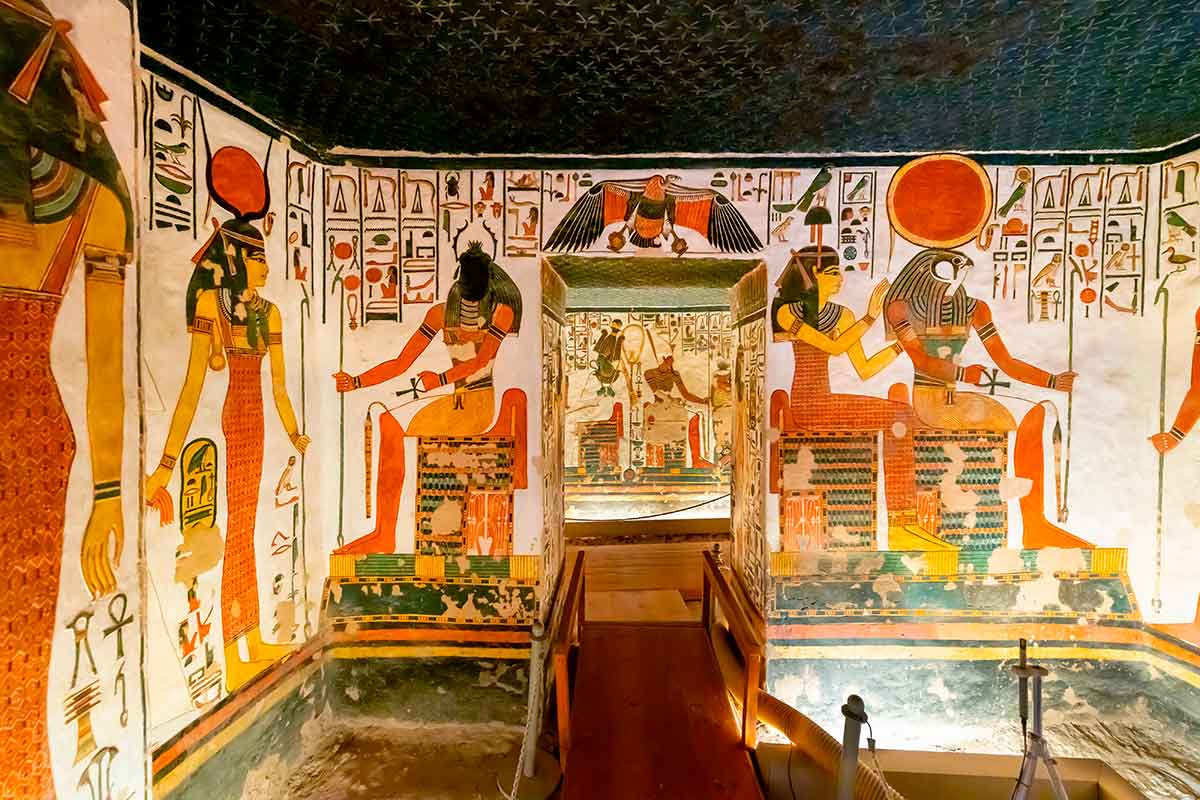
The Valley of the Queens responds to the same typology as that of the Valley of the Kings : a wadi or valley without a watercourse, in this case located in the southernmost area of the Theban necropolis, destined for the rest of royal wives, but also princesses, princes and other important members of the court. There are more than 70, although not all are open to visitors. In any case, they are well worth adding to your list of things to see in Luxor. They are numbered according to the same criteria: QV (Queens Valley) and a number. Among them, the following stand out:
The tombs of kings, queens and princes are not the only ones to see in Luxor: on the West Bank there are also others dedicated to nobles or local rulers who also did not want to miss the opportunity to be buried with full honors. The so-called Tombs of the Nobles are located near the Ramesseum and are embedded in the rock as a bunker. There are hundreds of them, although only a few are open to visitors. Some of them have a truly rich decoration. One of the most interesting aspects is that, unlike the iconographic programs of the pharaohs and queens, here you can learn more specific details about the daily life of the Egyptian civilization, as it was more than 3,000 years ago.
If you still have energy, these are the ones you can add to your list:
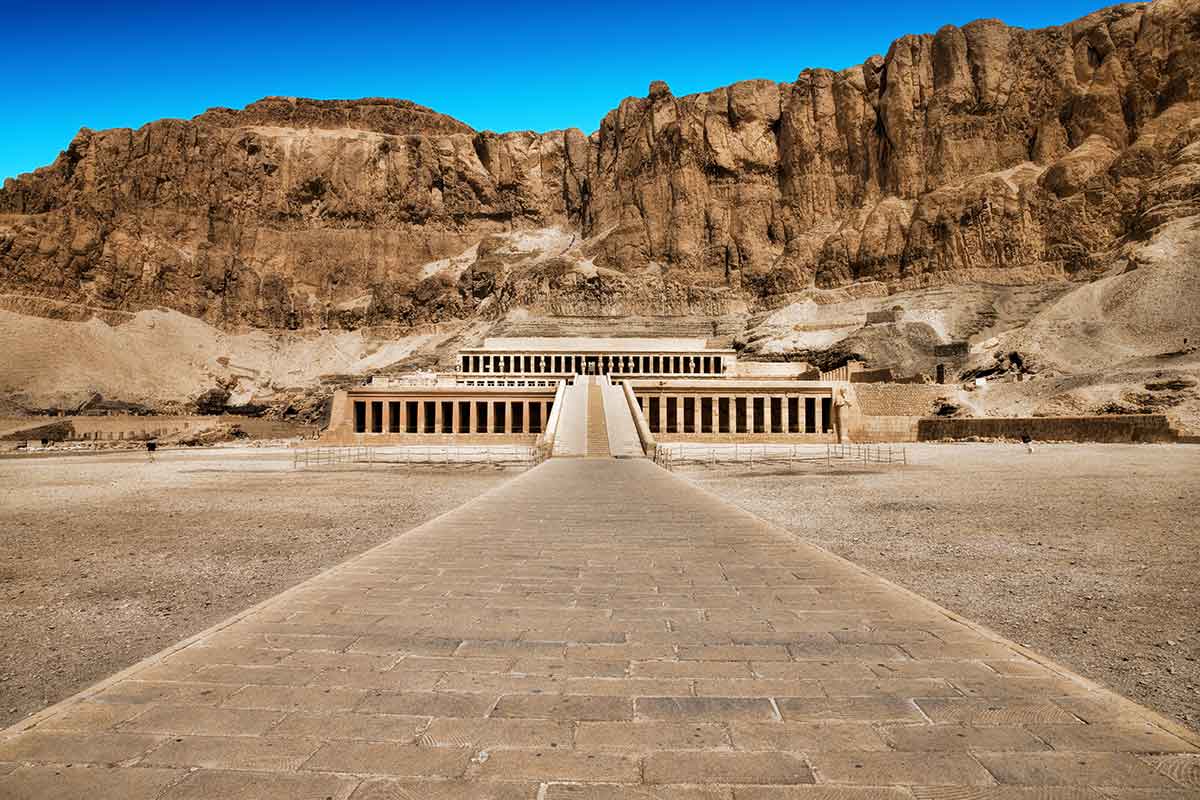
Apart from the tombs, there is much more to see in Luxor and on its West Bank. For example, temples of great symbolic and religious value, such as Deir el-Bahari. It is one of the most sacred sites on the West Bank and, therefore, cannot be missing from your list of things to see in Luxor. In fact, it is not only a classic of bus tours, but also of hot air balloon rides, thanks to its unique location at the foot of huge cliffs.
The name Deir-el Bahari refers to a group of three funerary temples: that of Mentuhotep II, that of Thutmose III (the latter further away, next to the cultivated fields) and that of Hatshepsut. A term that refers to a Coptic monastery and cemetery that was here. The oldest of the three temples was that of Mentuhotep II, oriented to the east, probably in a sign of adoration to the god Ra: a key pharaoh in the beginnings of the Middle Kingdom, the first period of splendor of ancient Thebes. The most ‘recent’ of the three was that of Thutmose III, probably abandoned due to a strong collapse during the 20th dynasty. Of one and the other, only ruins remain with little capacity to move.
On the other hand, the most famous temple is that of Hatshepsut, although its state of conservation is not exactly enviable. The blame was not due to looters or natural disasters, but to her son, the aforementioned Thutmose III. Hatshepsut was the daughter of Thutmose I and married her half-brother Thutmose II, with whom she had the future Thutmose III. Upon the premature death of Thutmose II, Hatshepsut assumed power as regent and, with the support of the clergy of Amun later, she rose as queen-pharaoh. She assumed the masculine attributes of the position and had this great temple built, to which she gave total solemnity, as indicated by its original name: Djser-Djeseru (Sacred among the Sacred). Her son, Thutmose III, disputed the throne and assumed it upon the death of Hatshepsut, making one suspect that he had something to do with it.
What is clear is that he dedicated himself to destroying his mother’s temple. Much of its current appearance is due to a controversial restoration, especially due to its symmetry, carried out in the mid-20th century by a team of Egyptian-Polish experts. In any case, it was a very unique enclosure, built in terraces and with elements that make it a precedent of Greek and, therefore, Western architecture, as is the case with the protodoric columns of the chapel of Anubis. Of what is preserved, the decorative bas-reliefs and the capitals of the columns of the chapel of Hathor can be highlighted.
Scattered throughout other areas of the West Bank there are many other things to see. In Luxor , thanks to its role as political and spiritual capital during a good part of the history of Ancient Egypt, there are monuments closely linked to different pharaohs. For example, to Amenhotep III (Amenhotep III) . It was this monarch of the 18th dynasty who ordered the construction of a huge temple on the west bank of the Nile, one of the largest of his time, with two gigantic sculptures of himself at the entrance, next to his wife and his mother, smaller in size: Tiyi and Mutemuia. Today, those sculptures are the only thing that remains of the temple and are known as Colossi of Memnon , so called because the Greeks, some time later, thought they were representations of King Memnon, greeting his mother, the goddess of the dawn Eos, every morning.
You will see the Colossi of Memnon on your way to the Valley of the Kings if you access by the Al Tmsalyn road. Shortly after the will appear Ramesseum, a funerary complex promoted by the great Ramses II, which also had other small temples dedicated to his mother Tuya and his favorite wife, the aforementioned Nefertari, as well as palaces, warehouses and other dependencies. Although little of it remains standing, its most famous elements are preserved: the colossi representing himself in the form of a mummy and Osirian position. However, most of the heads and busts are fallen on the ground or in other museums around the world. It had several pylons and several courtyards, as well as a hypostyle hall with large columns with polychrome and papyriform capitals, as can still be seen today. One of the most unique rooms is the astronomical hall, whose ceiling is decorated with a calendar based on the constellations. Much later it was used as a Christian church by the Copts.
This Ramesseum served as inspiration for the temple of Medinet Habu, erected by his successor Ramses III and certainly worthy of being included in the program of things to see in Luxor. There is no unanimity about its name, although it could be a reference to the royal scribe of this pharaoh, named Hapu. It was an administrative center with the appearance of a walled city, which in fact served as a refuge for the inhabitants of the ancient city of Thebes in situations of danger. It also had temples, chapels, lodgings for officers and priests, as well as a royal palace. It was also used as a Coptic village with a church later, although it was abandoned in the 9th century AD. In some parts of the site, intense polychrome decoration is preserved, which allows us to imagine how dazzling this and other constructions of its time must have been.
In the northern area of the West Bank is located another construction of enormous value: the temple of Seti I. Among so much magnificence, it usually goes unnoticed, also because it has reached us mistreated by time. But if you have time, it is highly recommended to make a space for your visit, although among so many interesting monuments to see in Luxor, it will be complicated. It was the funerary temple of this pharaoh of the XIX dynasty, very important during the New Kingdom because it reestablished the splendor lost during the Period of Amarna and laid the foundations for his son Ramses II to consolidate and expand the hegemony of the country in the region. Of the enclosure, located next to the road that leads to the Valley of the Kings, the portico with columns with papyriform capitals and a hypostyle hall that resembles that of Karnak are mainly preserved, since he himself promoted it. Its reliefs are elegant and a very good example of the art of Ancient Egypt.
Logically, Medinet Habu, the Ramesseum, the temple of Seti I and all the monuments to see in Luxor were built by someone. That ‘someone’ were the workers and artisans who worked hard in the area. And luckily, part of their place of residence is preserved, not very distant from the aforementioned enclosures: Deir el-Medina. Although only the bases of their houses remain standing in this town, it is an interesting source of information about daily life in Ancient Egypt, which archaeological research has been able to decipher. For example, the remains of food have made it possible to understand that their diet was based on fish and cereals, with some fruit and honey and, less habitually, meat, which was accompanied by the most popular drink: beer. Products that, in addition, were the ‘currency’ in which they charged their salary in kind. Its small necropolis indicates that the modest mortuary chambers were crowned with tiny pyramids.
Medinet Habu is not the only place that, in one way or another, has ethnographic value. We can also cite, with enormous differences between them, Gurna (or Gournah) and the House of Howard Carter. Gurna is the town in which, even today, a handful of inhabitants live. Located near the Tombs of the Nobles, its humble houses bring a little color to this desert valley. For a long time they have gained the fame of looters of the nearby treasures, but at present they benefit from tourism in the area in a much more legal way: they are artisans, farmers, traditional bakers or other humble professionals.
The House of Howard Carter, for its part, is the house in which one of the most famous archaeologists of all time resided, especially for his unwavering faith in the discovery of an intact tomb, which he achieved by discovering that of Tutankhamun. It is preserved practically as this British researcher of the early twentieth century lived in it. It can be an interesting place to see in Luxor for lovers of Egyptology and its emergence.
Without a doubt, there are several museums to see in Luxor for the enormous value of the pieces exhibited, which to a large extent come from the nearby monuments and detailed here: the temple of Luxor, the temples of Karnak and the entire West Bank, including the Valley of the Kings. Thanks to the fact that they have air conditioning and internal elements designed to understand their context, visiting them can be a good option for those hours when the heat is most intense in the city.
It is not only the most important thing to see in Luxor, but also one of the most interesting in the whole country. Its structure is modern and, although it has many fewer objects than the Egyptian Museum of Cairo, here they are exhibited with much more order. It also shows audiovisual content in certain rooms. Probably the most interesting are:
The gallery dedicated to Akhenaten (Amenophis IV), with sculptures and reliefs from elements he added in the temples of Karnak. Some show scenes of daily life and others, the characteristic cult of the solar disk Aten
Despite this name, excessive mummies are not exhibited nor is the focus placed on the most gruesome details of this post-mortem task, essential to preserve the body of the deceased and, therefore, to aspire to eternal life in the afterlife. The most important mummy is that of Masaharti, high priest of Amun-Ra in the period of the XXI dynasty. And it is because of its surprising state of conservation, as it still maintains hair and beard.
The museum has many other curiosities. For example, mummified animals, such as cats or baboons. Or the instruments used to empty the body of the deceased , extracting his brain or his viscera. All this makes this museum one of the most interesting things to see in Luxor, although in an hour you may have already seen everything. After that, we recommend you have a drink in its cafeteria, as it has views of the Nile River.
Now that you know everything to see in Luxor, we give you practical information that will help you organize your trip and your stay in this city. We focus on how to get there, how to get around and in what places you can obtain more detailed information in person. And we remind you that if you need a professional and expert agency to do all this work for you, you can contact Egipto Exclusivo: we will provide you with private transport, accommodation and professional guides so you don’t miss any detail.
Fortunately, Luxor International Airport is very close to the city: it is located just 8 km from the center, a distance that is covered in just 15 minutes by road. Given the location of Luxor in Upper Nile, without large cities around it, the option of the plane is presented as the only one if you want to travel here from another country. These are the destinations directly connected to Luxor by air.
If your place of origin does not have a direct connection with Luxor, your options are to make a stopover in the capital, Cairo, although you can also organize your itinerary with origin or destination in a coastal tourist city, such as Sharm el-Sheikh or Marsa Alam.
Some believe that seeing Luxor within a wider circuit is possible. If that is your case, you can travel here by bus, preferably if it is private for reasons of comfort. The train is also an option, as the central station is less than a kilometer from the temple of Luxor: the line that operates this line is the one that connects Cairo and Aswan, this city being a stop on it. They are night trains that have beds.
Finally, you can also consider visiting Luxor as part of a cruise on Upper Egypt, either in a traditional boat like ours (feluccas and dahabiyas) or in a larger motorboat.
The monuments to see in Luxor city are not very far from each other, although to save energy or speed up time, you can use means of transport alternative to your own legs. As in almost all Egyptian cities, the taxi is a much more recommended option than the urban buses used by the local population, without the conditions of comfort and punctuality that one would expect. The price of a short taxi ride through the city will be around 20 LE, although prices can also be negotiated for one or several full days. In that case, we remind you that Egipto Exclusivo can take care of providing a private taxi with a driver at your entire disposal.
Special mention deserve the calesas (calèche): traditional horse-drawn carriage that has a lot of presence here as a means of transport. Whether you use them or not, you must be patient because their drivers can be very insistent. In any case, you should calculate about 30 LE for a trip from the center to the temples of Karnak.
In this city, as we have mentioned in the section ‘What to see in Luxor‘, the river ferry has a very important role: given the absence of bridges in the center (the nearest one is 8 km to the south), this is the way to cross the river from the city (eastern shore) to the West Bank, where the Valley of the Kings and the other funerary monuments are located. The pier is located next to the temple of Luxor and from there this small ferry leaves approximately every 10 minutes, at a cost of about 2 LE.
To cross the river, another alternative to the ferry or the distant bridge are the private motor boats. They function as a taxi and can pick up passengers from any point on the shore. The approximate price of this service is 20 LE.
The bicycle can also be a means of transport with which to see Luxor and its main monuments. The city is relatively small and compact, with hardly any slopes, so any urban displacement only entails the difficulty (and the risk) of local traffic. There are places that rent them, at prices that are around 10 LE per hour or 25 LE per day. There is also a rental place on the West Bank. The most daring are encouraged to climb to the Valley of the Kings with this means of transport. But if you do, make sure that the bicycle will respond well and that the hours in which you pedal are not of maximum heat, because otherwise it can be really hard.
In the square of Midan Al Mahatta, on the other side of the train station, is the main information office: it has brochures in different languages and ticket sales, such as for the night show of light and sound in the temples of Karnak. There are also other smaller stalls inside the station itself and in the airport terminal.


