The Tutankhamun Gallery has undoubtedly been the best-kept secret of the Grand Egyptian Museum in Giza. And after its grand
What is the Tutankhamun Gallery?
The name Tutankhamun Galleries refers to a wing of the Grand Egyptian Museum in Giza that displays a selection of the 5,000 objects found in the tomb of this pharaoh. Let us remember that, in 1922, the archaeologist
This gallery, by the way, has been named the ‘Golden Gallery’ or ‘Gallery of Golden Treasures’ because a good part of the pieces on display are made of solid gold or have a treatment based on the most precious metal, which gives a special tone to each showcase displayed here.
In fact, its arrangement in showcases is now much more spectacular than it was in the Egyptian Museum in Cairo: with a more subdued general atmosphere, a directed and focused lighting towards the objects, and more space between each of them, the visitor can admire each piece much better, until they are absolutely speechless.
Main pieces exhibited
Although the GEM is the largest archaeological museum in the world and its dimensions are pharaonic, the Tutankhamun Gallery has opted to show a selection of those 5,000 objects that made up the tomb of the young pharaoh. And this selection does not lack any of the star pieces, which we list below:
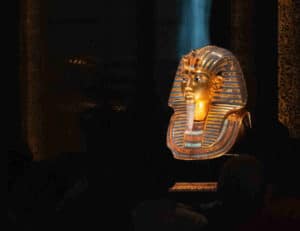
- Funerary mask: an authentic icon of the museum. It is a mask made of solid gold and decorated with semi-precious stones, composing an object of more than 10 kg in weight. On the back, beautiful hieroglyphs engraved, and on the face, youthfully idealized features, which have bequeathed us the universal image of this famous pharaoh.
- Golden throne: throne configured as an armchair with armrests in whose backrest you can see a scene of the pharaoh with the queen under a floral canopy and the rays of the solar disk Aten, which suggests that it dates from the beginning of his reign. It is made of wood covered with sheets of chiseled gold.
- Outer coffin: made of wood covered with plaster, linen, and a very thin layer of gold, it impresses with its robustness and, at the same time, with the tenderness and magic of the face.
- Ostrich hunting fan: gold fan named for the scene depicted in relief that was also originally decorated with ostrich feathers.
- Ceremonial chariots: spectacular chariots that Carter found disassembled but are now assembled in their original position, which allows us to admire the spectacular nature of its wooden structure covered with gold sheets and ivory inlays.
- Canopic box: ark intended to preserve the internal organs of the pharaoh, causes admiration not only for the beauty of the carved and polychrome heads, but above all for the delicacy of the travertine (or Egyptian alabaster) used in its preparation.
But this is just a small selection of everything that is exhibited, which also includes statues such as the guardian of the ka, ceremonial jugs and cups, jewels and many other everyday objects full of charm, which accompanied the pharaoh on his journey to the Afterlife and which now do the same with visitors on their journey through the Tutankhamun Gallery of the Grand Egyptian Museum.