
If you decide to take an excursion to the city of Rosetta, the most genuine Egypt will appear before your eyes. The name of this city may sound familiar because of the Rosetta Stone, whose discovery revolutionized knowledge about Ancient Egypt. It may also sound familiar because that name is given to one of the two branches into which the Nile divides in the Delta: the Damietta and the Rosetta.
However, if we are honest, we cannot say that the most touristy city in the country is Rosetta. Egypt has many other destinations that surpass it in beauty and, above all, in tourist infrastructure. However, it offers some attractions that may interest travelers who are most in love with the country. . Therefore, our agency gives you the possibility of organizing a half-day or full-day excursion from Alexandria or from Cairo. And on this page we give you some hints about what to expect.
Rosetta (in Egypt, known as Rashid or Rasheed) is a relatively small city located very close to where the western branch of the Nile River flows. And we say ‘relatively’ because, like the rest of the country, it has grown a lot in recent years: from about 50,000 inhabitants at the end of the 20th century to about 300,000 today. Administratively, it belongs to the Behera Governorate.
Although it is located very close to the Mediterranean, it does not fall within the tourist concept of ‘Mediterranean coast‘, but within what is understood as the Nile Delta, since it does not have beaches that can be exploited for tourism. On the other hand, this location does allow it to have a climate that is more temperate than in the rest of Egypt, with temperatures that do not usually exceed 31 ºC in summer and do not usually fall below 10 ºC in winter.
There is not much data on the role that Rosetta played in Egypt Ancient, although due to its unique location it is reasonable to think that it was of relative importance. However, it must be borne in mind that at that time the landscape of this region was very different, since the Nile had not only two branches but seven. The fact that the city probably changed its name several times during ancient and Ptolemaic times does not help to know the true importance of Rosetta.
There is somewhat more information about Rosetta in Egypt Islamic, after the Arab conquest. This is due
Under Turkish rule, from the 16th century onwards, the city began to experience a period of growth at all levels. And this continued even until the 19th century, with its Ottoman-style buildings and mansions being a beautiful testimony, as we show below. It was a time when its port could boast of being one of the most important in the country and its city, a regular destination for British travelers.
The city was also a direct witness (and direct victim) of the battles in the context of the Napoleonic Wars and the Egyptian Campaign: in 1799 a new French conquest took place in which the Rosetta Stone was ‘captured’ and Egypt was immersed in fierce fighting between the French and British. Two years later, despite the French defeat, the British did not return the Stone to its original place, but it became part of the British Museum in London, where it is exhibited today.
The 20th century was, on the other hand, a time of decline, with its port already relegated to a secondary role with respect to that of Alexandria. Currently it is still not part of the major tourist circuits and this allows the city to have its own pace of life, closer to the rural world in some aspects and with corners where time seems to have stopped. In any case, some recent reforms and rehabilitations leave the traveler some room for maneuver to organize a program with cultural visits during their stay.
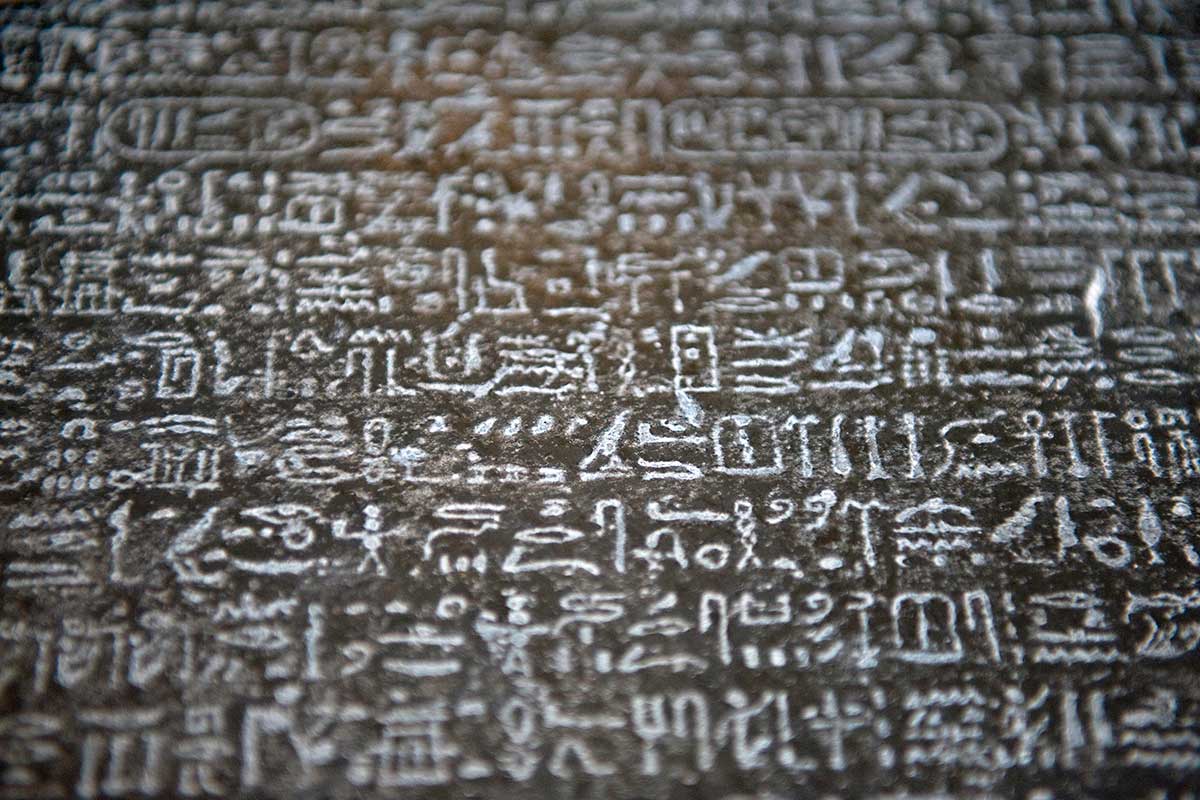
Many travelers, when taking their first steps in the world of Egyptology, wonder what importance the Rosetta Stone had.. And although today it may seem like just another piece of rock, like so many others with engravings from the Pharaonic era, at the beginning of the 19th century it caused a real sensation.
Before getting to that point, let’s put ourselves in context to understand what importance the Rosetta Stone had. This name refers to a piece of stele, engraved in granite, which was probably exhibited in a temple in nearby Sais, an important city of Ancient Egypt that became a royal residence during the Late Period but ended up disappearing after the Arab invasion. In medieval times, Sais served as a real quarry, with numerous ashlars from ancient Pharaonic buildings being used to build new structures in the Delta.
It was then that the stele was dismantled and moved to Rosetta to be used as construction material in the fortress of this city. Centuries later, during the Napoleonic invasion, a French soldier discovered it during remodeling work, and it remained in the custody of his army. But in 1802, after the capitulation to the British troops, the piece was shipped and taken to London.
This is the story of its discovery, but what importance did the Rosetta Stone have in Egypt Ancient and in modern Egyptology? To understand it, you have to look at the engraved text: it is an agreement between the Egyptian clergy and Ptolemy V so that the latter would be treated as a local deity. And so that everyone would understand it, it was written in three languages: hieroglyphic, demotic and ancient Greek. .
At the time of its discovery, hieroglyphic writing had not yet been deciphered: it remained a mystery that prevented knowing the true meaning of the Pharaonic civilization. But thanks to a comparative study of the texts, it was possible to ‘decode’ the text in hieroglyphics and, with it, shed light on an ancient culture that was being rediscovered by the whole world. The great architect of that ‘translation’ was Jean-François Champollion in 1822.
Currently, the Rosetta Stone is a source of pride for the local population, as it makes the name of their city known to half the world. But those who visit now Rosetta and Egypt will have to settle for a replica, as we show below.
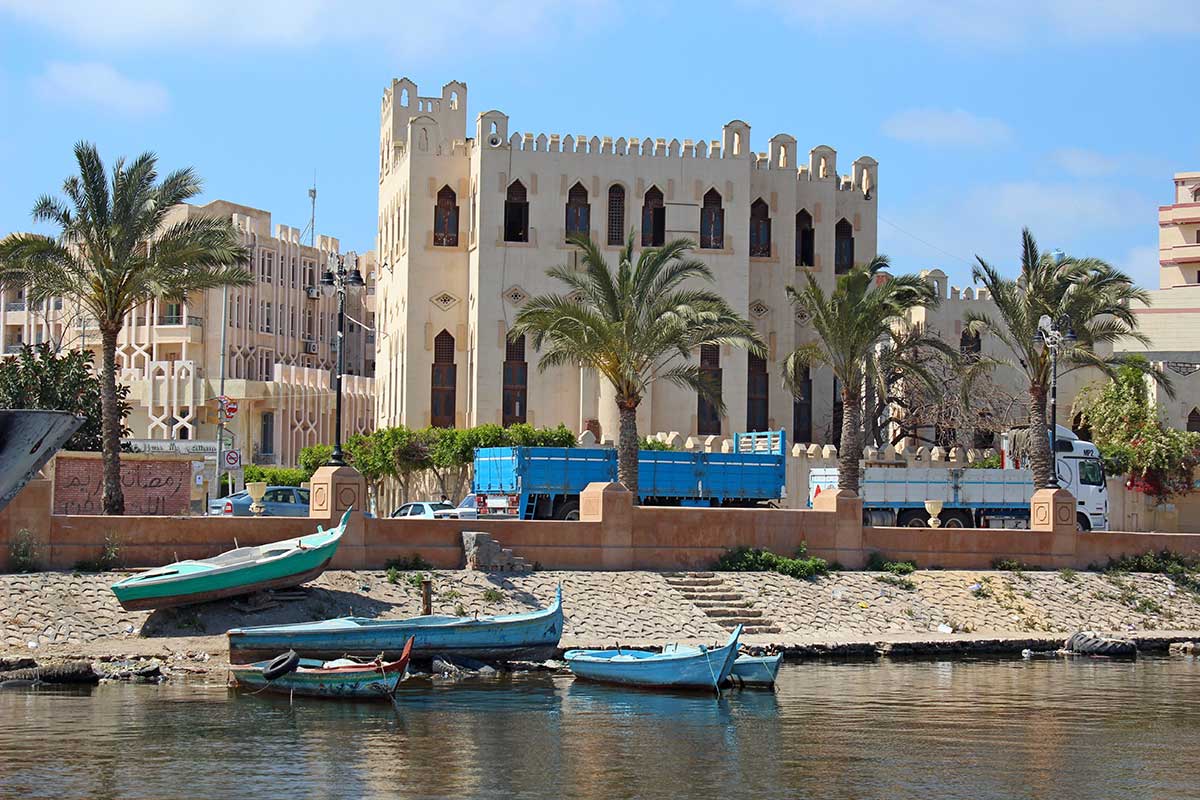
Rosetta is not a tourist city. And, from what it seems, it does not have much intention of being one either , judging by the limited development of tourist infrastructures, such as museums and hotels. Therefore, the places of interest that we indicate below should be visited in a single day, without overnight stay, as an excursion from Alexandria or Cairo.
The most impressive monument is, perhaps, the Rosetta fortress, also known as Fort Julien. It is located about 5 km north of the city, on the banks of the Nile River and about 4 km from the mouth of the Mediterranean. It was built in Arab times, at the end of the Mamluk period, in the 15th century, during the reign of Sultan Qaitbay, who also promoted the fortification of the port of Alexandria with a castle that bears his name. It was subsequently reinforced, in the 16th century, and especially in 1799, by the French army. As a result of these works, the Rosetta Stone was discovered and the complex acquired its final plan, with the bastions at its corners.
The Ottoman-style mansions and houses are another hallmark of Rosetta. In Egypt , on the other hand, it is not very common to find this type of building, which gives a very original touch to some streets of the city. You will easily recognize them, by the following characteristics:
Two beautiful examples of this type of architecture are the House of Amasyali and the House of Abu Shaheen. Both have been restored and are open to the public so that they can learn how they were distributed internally, how the ceilings were decorated, what furniture decorated the rooms or what machinery was used for daily tasks.
Another building that also presents this type of architecture is the Rosetta Museum (Rashid Museum), recently restored. It is here where you can understand a little better what importance the Rosetta Stone had, since a replica is exhibited in its rooms. The rest of the building functions as an ethnographic museum.
The Islamic architectural heritage is also interesting in Rosetta, and Egipto Exclusivo can configure a route with the most interesting mosques. Of all of them, the one of Abou Mandour stands out probably on the banks of the Nile River. Or that of El-Abbasi, small but where the influence of Ottoman architecture is well appreciated , both in the minaret and, above all, in the aforementioned succession of red and black bricks.
And if what you want is to wander through the city to know the similarities and differences between Rosetta and Egypt, you can take a walk through its main souk, which extends through streets of the center, such as Sharia Port Said, near the House of Amasyali.
As it is a city that is not very touristy and not as populated as others in the Nile Delta, the only way to access Rosetta is by road: it has no airport or train station, and the stretch of river that bathes the city is not navigable. Therefore, you can use the regular bus line, the so-called minibuses, used by the Egyptian population, although their services are not designed for foreign tourists.
Private transport is the other option that is presented to you to travel by road to Rosetta. And Egipto Exclusivo can provide it as part of a full-day excursion to this city, also taking care of including other services, such as the tour of the city and lunch, if you wish.
We can organize this service from any point but, above all, from Cairo and Alexandria. These are the distances and times of this trip:
If you need more details to travel to Rosetta, Egypt Exclusivo is at your disposal to plan this excursion and integrate it into a wider circuit, if you need it. Contact us now and organize a day different from what tourists are used to doing!


